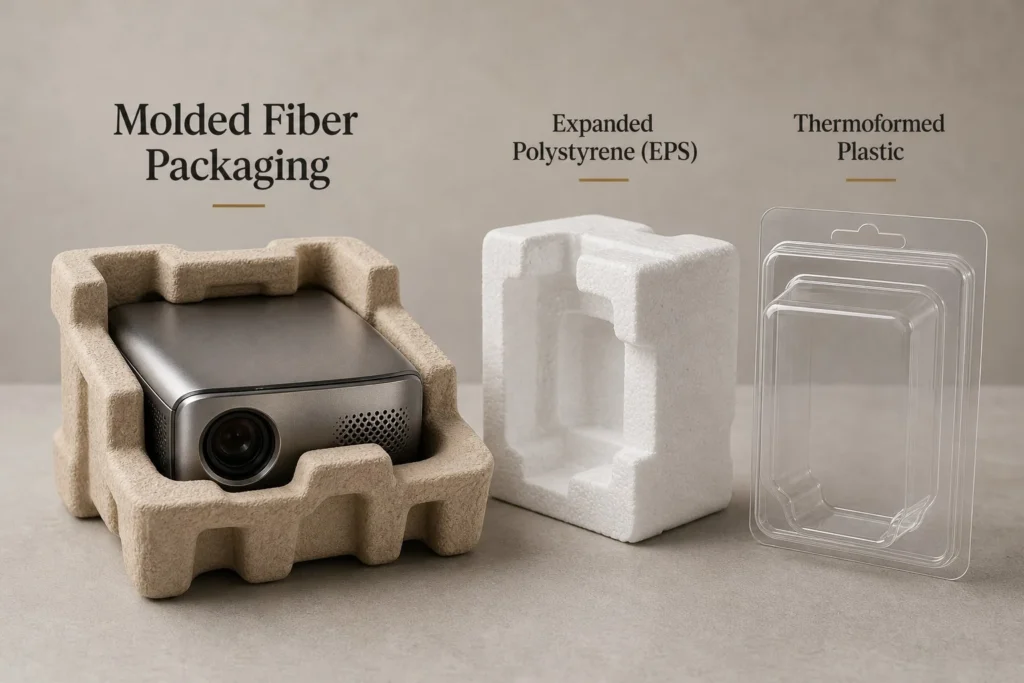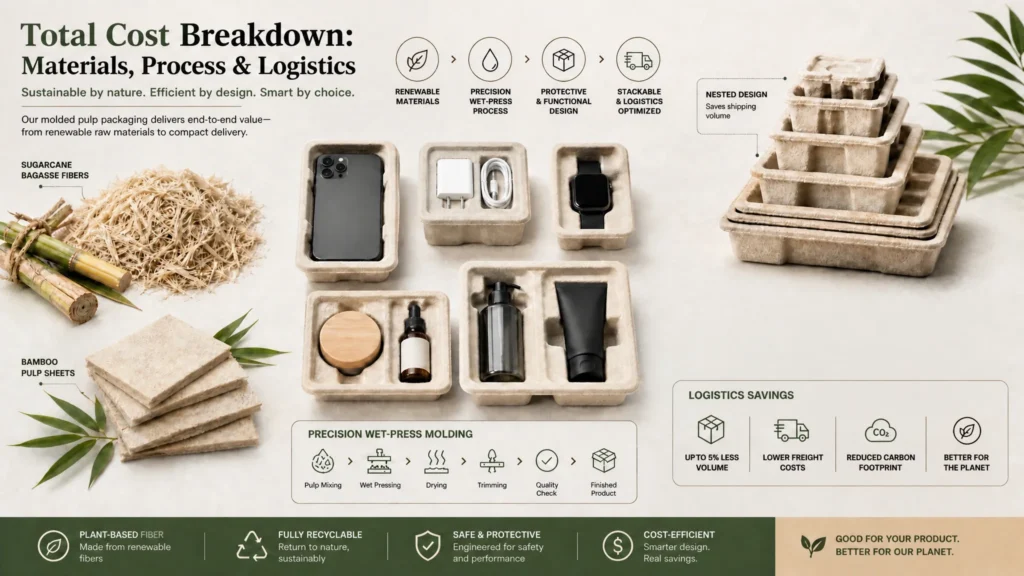
Most packaging briefs do not fail on one component. They fail where two components meet. The insert is drawn to the product, the carton is drawn to a catalogue size, the band is ordered from a printer who never saw either, and the mismatch shows up on the first production run as a lid that will not close or a product that rides up on a drop. An integrated pack is the alternative: locating parts, carrying parts and closing parts drawn to one set of dimensions, quoted together and delivered to one date.
What This Category Covers
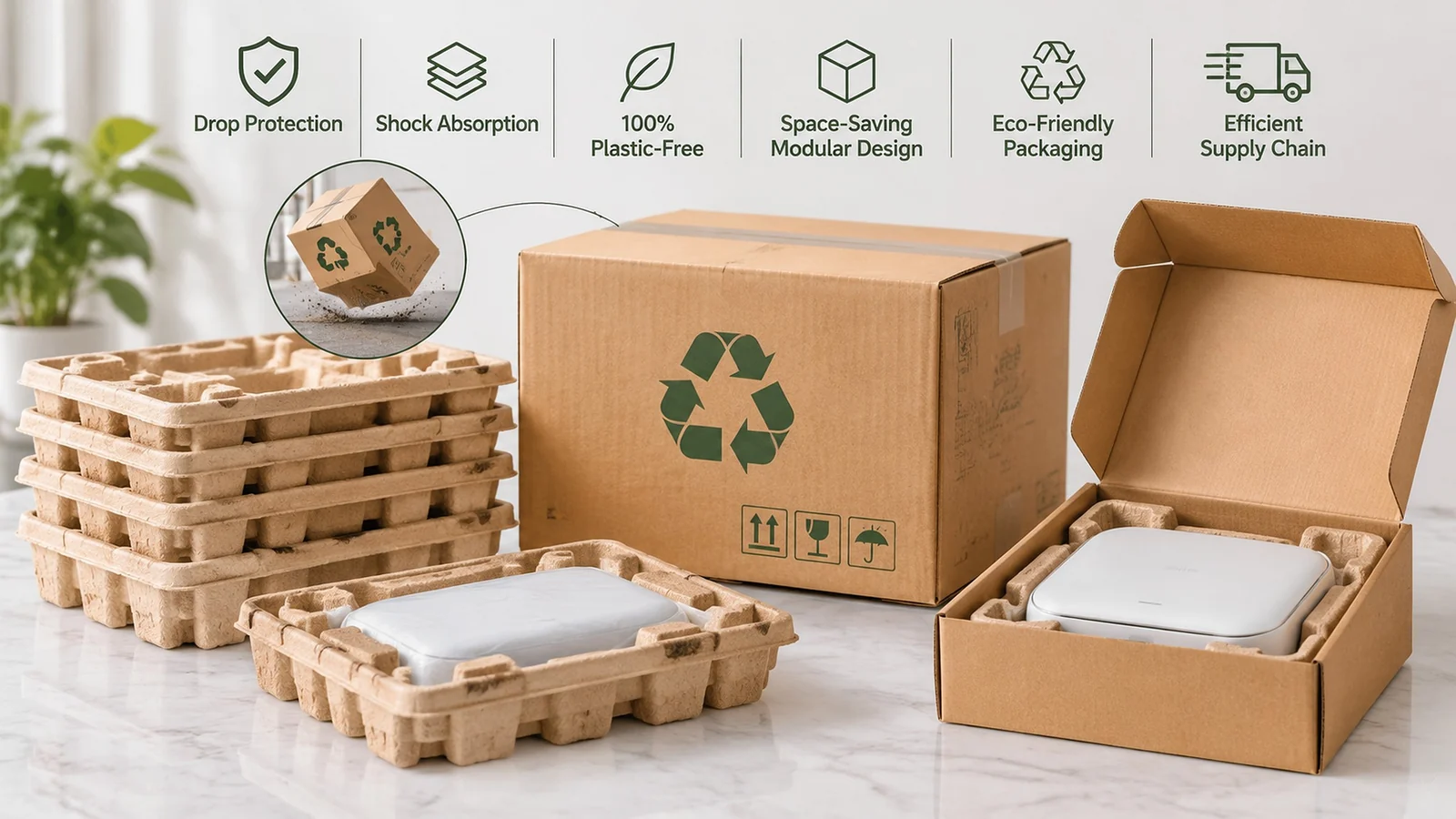
This category collects packs where molded pulp is one part of a larger set, not the whole story. A single dry-press tray in a mailer is a tray. A tray plus an upper pad plus a die-cut corrugated carton plus a printed band is an integrated pack, because the four parts only work at their designed dimensions when they are designed together.
The range keeps growing, and the combinations are not fixed. What stays constant is the logic: one part locates, one part carries, one part closes, and everything is drawn from the product outward rather than from a stock box inward. Browse the category index at integrated packaging solutions for what is currently tooled.
The Four Component Families
| Family | Typical parts | Job in the pack |
|---|---|---|
| Locating | Dry-press or wet-press pulp tray, insert, pod, upper pad | Holds the product at the dimensions it was drawn to; absorbs shock through the fibre wall |
| Carrying | Die-cut corrugated carton, rigid greyboard box, sleeve | Provides stacking strength, the outer surface, the print and the parcel identity |
| Closing | Printed paper band, wrap, label, tuck flap | Keeps the pack shut, carries the brand and the legal panel, and can replace tape |
| Carrying out | Paper carrier bag, handle, inner wrap | Moves the finished set through retail or gifting without a second outer |
Most briefs use two or three of these families. All four is a retail gift set; two is a shipper. The number of families is a commercial decision, not a technical one, and it is worth settling before any drawing starts.
Five Combinations That Cover Most Briefs
| Combination | Usually used for | What it solves |
|---|---|---|
| Insert + corrugated carton | Parcel-shipped devices, luminaires, bottles | Locating plus stacking strength without a second overbox |
| Insert + rigid box + band | Retail and gifting, cosmetics, spirits | Shelf presence with a printed face; the insert stays unprinted |
| Base insert + upper pad + carton | Bottles, shades, anything with a shoulder | Stops the product rising on a drop without clamping it |
| Molded shell + band | Small sets where pulp is the box | Removes board entirely; the band carries print and closure |
| Insert + carton + carrier bag | Gift and subscription sets | One pack that ships and is handed over without repacking |
The same product can move between rows as the channel changes. A bottle that ships as row three to a distributor may go to a retailer as row two, with the same pulp cavity and a different outer. That is the practical argument for drawing the pulp to the product first and treating the outer as the variable.
Why the Parts Have to Be Drawn Together
Three things only exist at the interface, and none of them belongs to a single supplier:
- Clearance. The insert has to slide into the carton without preload, and the carton has to close over the insert without lifting it. That number is a stack-up across two materials.
- Load path. Stacking force travels from the carton walls into the insert, not into the product. If the insert is drawn two millimetres proud, the product becomes the column.
- Print position. A band sits on the pack at a fixed height; that height depends on the insert thickness and the carton fold. Change one and the band misses.
Buying the parts separately does not fail because suppliers are careless. It fails because each supplier is optimising a tolerance the others cannot see. Drawing the set together puts one party on the hook for the fit, and it usually removes a second sample round.
The Tolerance Chain, in the Order It Fails
Molded pulp is the tightest part of most sets. Wet-press holds roughly 0.8 to 1.5 mm wall and a cavity tolerance around plus or minus 0.03 to 0.05 mm; dry-press runs 1 to 3 mm and plus or minus 0.08 to 0.15 mm. Die-cut board is looser than either, and rigid box wrapping adds thickness on all four sides.
The sequence that works is: product drawing sets the cavity, the cavity plus wall sets the insert outside dimension, the insert plus clearance sets the carton inside dimension, and the carton plus board thickness sets the outside. Doing it in that order means the only loose tolerance sits on the outside, where nobody sees it. Doing it in reverse means the pulp has to absorb every error in the chain, which is how cavities get redrawn. The difference between the two pulp processes is set out in wet-press versus dry-press.
Tooling: How Many Tools a Set Actually Needs
Each molded pulp part needs its own tool, and each board component needs its own die. That arithmetic surprises buyers more often than the unit price does:
- Insert only, in your carton. One pulp tool, no board die.
- Insert plus corrugated carton. One pulp tool plus one carton die.
- Base, pad and carton. Two pulp tools plus one carton die.
- Insert, rigid box and band. One pulp tool, one rigid box die, one wrap die, one band die.
Pulp tooling starts at US$2,400 per tool for a dry-press part and is quoted per drawing; carton and band dies are quoted with the board component. A four-part set therefore carries four tools, which is the real reason a set is worth committing to rather than sampling. Tooling and MOQ are broken down on the cost, tooling and MOQ page.
Where the Cost Sits
| Component | Main cost driver | Usual lever |
|---|---|---|
| Pulp insert | Cavity complexity, tool count, order quantity | Simplify ribs; one cavity instead of three |
| Corrugated carton | Board grade, die complexity, print colours | One-colour print on kraft; stock flute height |
| Rigid box | Hand wrapping, board thickness, print finish | Smaller board area; drop a lamination |
| Band | Width, print process, application method | Single-colour flexo; self-adhesive instead of glued |
| Bag | Paper weight, handle type, print | Twisted paper handle instead of rope |
Unit cost follows quantity, but the ratio between components does not. Above roughly five thousand sets the pulp stops being the expensive part and the printed board starts to be, which is why the print decision is worth making last rather than first.
What the Assembled Pack Has to Survive
A set is tested as a set. Drop, compression and humidity behave differently once an insert sits inside a carton, and a pack that passes as components can still fail assembled because the insert transfers the load into the board rather than into the fibre. Transit tests are quoted on the assembled pack, and the documents a retailer usually asks for are a test report and a material declaration rather than a certificate for the pulp alone. The paperwork route is set out in our molded pulp overview.
What to Send to Quote a Set
- Product outline in three views, with the weight and the centre of gravity.
- The dimension that must not move: base diameter, footprint or mounting face.
- Pack count per carton and the stacking height the pallet will see.
- Channel: parcel, pallet to retail, or handover at a counter.
- Print artwork and the number of colours, if the board is printed.
- Any document the buyer already promised: test protocol, declaration, artwork approval route.
With those six items a set can be drawn and quoted in one pass. Without them the quote is a guess, and the sample round becomes the place where the scope gets discovered.
What Is Tooled in This Category Now
- Six-bottle shipper: dry-press base tray, upper pad and die-cut kraft carton for glass bottles.
- Rice gift set: wet-press outer box, portion pods, printed bands, rigid gift box and carrier bag.
- Lighting fixture pack: two dry-press inserts, one locating the body and one capping the shade, inside a printed carton.
- Clamshell and carton set: a hinged pulp clamshell with a printed corrugated outer for craft drinks.
These are examples, not the menu. New combinations are added as they are tooled, and a set that does not exist yet is the normal starting point. If the pack carries food or drink, the cavity and food-contact questions are covered in the food and beverage guide.
Frequently Asked Questions
Can I buy only the pulp insert and use my own carton?
Yes, and it is common. Send the carton inside dimensions and the board grade, and the insert will be drawn to fit that box with a defined clearance. The caveat is ownership of the fit: once the carton comes from another supplier, any mismatch at the interface is a shared problem, so the clearance has to be agreed in writing before tooling.
Who is responsible when two suppliers are involved?
Whoever holds the drawing set. If the pulp and the board are quoted together, the fit is ours. If they are not, we draw to the dimensions you give us and confirm them in the sample report, which puts the interface decision back with the buyer.
How many tools does a typical set need?
One per molded pulp part, plus one die per board component. A base insert, an upper pad and a carton is three tools. An insert with a rigid box and a band is four. Each pulp tool starts at US$2,400 and is quoted per drawing.
Is a printed band necessary?
No. It is one way to close a pack and carry the brand, and it is cheap to change later because the die is small. Where the print has to survive retail handling, a printed label or a sleeve does the same job with a different cost profile.
What is the minimum order for a set?
Pulp parts run from 5,000 sets dry-press and 10,000 wet-press. Board components have their own minimums, which is why a set is quoted as one order: the quantities are matched so the components ship in step.
How long does a set take from drawing to delivery?
Sampling runs 10 to 15 working days after the drawing is approved, and production 15 to 20 working days after sign-off. Board components are converted in parallel rather than after the pulp, so a set does not take the sum of its parts.
Send a Product Drawing and We Will Draw the Set
Send the product outline and the six items above, and the reply is a component list, a cavity layout, a tooling count and a quote for the whole set rather than for one part of it. If the brief is still open, the fastest way to narrow it is to decide how many of the four component families the pack actually needs.