


Product Overview
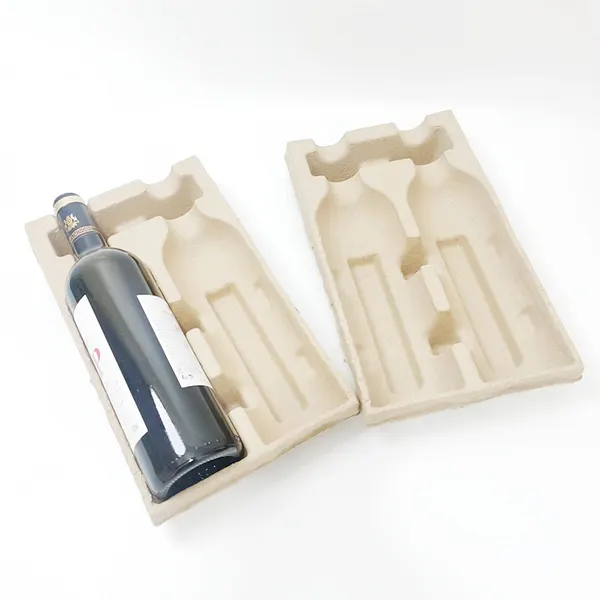
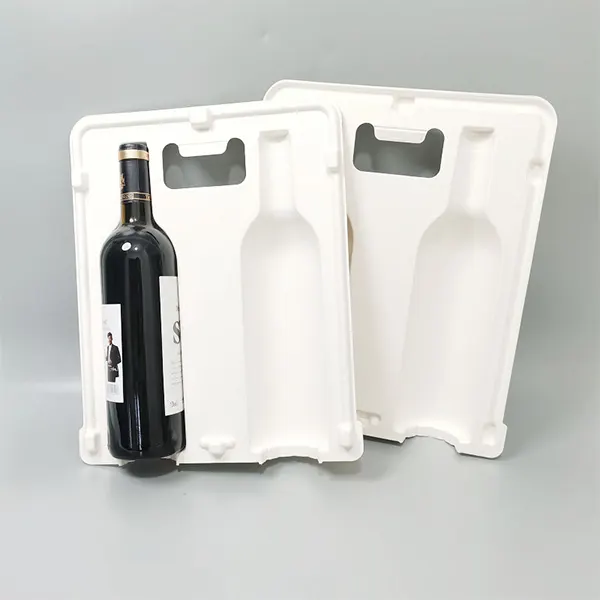
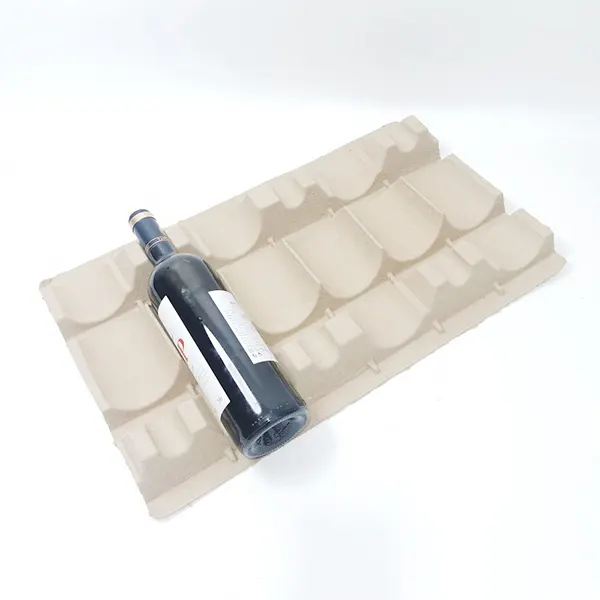
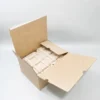
This is one pack, not a tray sold next to a box. A yellow-pulp dry-press tray carries six glass bottles by the base, a second dry-press pad presses down on the shoulders and closures, and a die-cut kraft corrugated carton closes over both. The pulp does the locating and the cushioning; the carton does the stacking, the print and the parcel label. Between them there is no foam block, no bubble bag, no plastic divider and no tape.
The photographs show the sample pack built around six amber crown-cap bottles: the tray with its six drawn cavities, the pad with raised rings that sit over the closures, and the carton printed with the brand, a fragile mark and a glass symbol. Everything below the carton wall is one material. Both pulp pieces are formed from undyed yellow pulp and press to a 1–3 mm wall, which is thick enough to hold a cavity shape and to take compression from the layer above.
Dimensions follow your bottle and your parcel route. Carton internal dimensions are set from the tray footprint plus the pad height, so the bottles cannot move vertically once the lid closes — that is the point of the second pulp piece, and it is the reason the pack can lose its foam without losing protection.
Key Product Features
- Six drawn bottle cavities — each cell follows the bottle body rather than a nominal cylinder, so the glass is located at the base and cannot walk across the tray in transit.
- Top pad over the closures — raised rings sit on the caps and hold the bottles down, which removes the vertical play a single tray leaves behind.
- Yellow pulp, dry-press 1–3 mm — undyed natural fibre with a matte face, stiff enough to hold a cavity under load and warm enough to sit exposed when the carton is opened.
- Die-cut kraft corrugated carton — one-piece blank with a folding lid, no tape and no staples, print carried on the outside face.
- One material inside — tray and pad go into the paper stream with the carton; there is no plastic component to separate before recycling.
- Nests flat for freight — trays and pads stack into each other, so a container carries pulp instead of air.
- Matched tolerances — pulp cavities and carton internal dimensions come from one drawing set, not two suppliers working from a photograph.
What Ships in One Carton
| Product packed | Why this format fits |
|---|---|
| Craft beer, cider and kombucha, 250–500 ml | Crown-cap and swing-top bottles are held by the base and pressed at the closure, so the caps cannot knock together in a parcel. |
| Wine and spirits, six-bottle parcel | A six-cell tray turns a case into a shippable parcel without a moulded foam shipper; the carton carries the fragile and handling marks. |
| Tonic, mixer and cocktail multipacks | Small-format glass gets the same cell depth, and the open tray lets a co-packer load by hand or from above on a line. |
| Subscription and club shipments | Print lives on the carton, which is cheaper to change per release than a pulp tool, so the seasonal artwork moves without new cavities. |
Material & Eco Advantages
Yellow pulp is unbleached and undyed, which is why the tray in the photographs reads as warm board rather than white card. The trade-off is honest: an undyed sheet is a little less bright than a white wet-press grade, and it hides scuffing better, which matters for a pack that is handled in a warehouse before it is opened by a customer. Wall thickness and tolerance are the same family as any dry-press part — 1–3 mm and ±0.08–0.15 mm — and the wet-press versus dry-press comparison covers where a thinner, tighter wet-press part is the better answer. The same tray-plus-carton principle, applied to other product types, is set out under our integrated packaging solutions.
Recyclability here is a component-count question, not a material claim. The pack has three pieces and all three are paper: tray, pad, carton. A moulded foam shipper with a laminated liner has to be separated before either stream will take it; this one does not. PPWR (EU 2025/40) applies to the packaging you place on the market — recyclability, recycled content over time, labelling — and is not a certificate a supplier can hold. What we can issue is a declaration: FDA status for the paper components under 21 CFR 176.170 and 176.180, and a restricted-substance declaration in RoHS format for a defined grade.
Product Specifications
| Material | Molded plant fibre, yellow pulp (natural, undyed), dry-press |
| Components | Base tray with six bottle cavities + top pressure pad + die-cut kraft corrugated carton |
| Cavity | Six cells drawn to your bottle body diameter and height; pad rings drawn to your closure diameter |
| Process | Dry-press, 1–3 mm wall, matte natural surface |
| Cavity tolerance | ±0.08–0.15 mm; a wet-press version reaches ±0.03–0.05 mm where a tighter cell is needed |
| Carton | Kraft corrugated, single-wall, die-cut one-piece blank with folding lid; flute grade set by the parcel and stacking load |
| Dimensions | Custom — tray, pad and carton set from one drawing at the tooling stage |
| Branding | Print on the carton (flexo or litho-laminate); deboss available on the pulp on request |
| MOQ | 5,000 sets for tray and pad (dry-press); carton quoted on the same order. Custom-formed, so no stock-mould route |
| Tooling | From US$2,400 per pulp tool — tray and pad are two tools — plus a cutting die for the carton. See the cost and tooling breakdown. |
| Testing | ISTA 3A on the assembled pack; compression test on the carton at the stacking load you specify |
| Sampling | 10–15 working days |
| Production lead time | 15–20 working days after sample approval |
| Terms | EXW, FOB, CIF or DDU |
Suitable Purchaser Groups
- Breweries and cider makers shipping direct — a six-bottle parcel that survives a courier network without a foam shipper or a plastic-wrapped divider.
- Wine and spirits brands selling online — the carton carries the brand and the fragile marks, so the parcel is presentable before it is opened.
- Brands that want one supplier for pulp and carton — matched dimensions from one drawing set, and one party accountable for fit.
- Brands replacing EPS or EPE inserts — same cell count, same bottle protection, one material at the recycling point; the hinged six-bottle clamshell set covers the closed-shell variant.
Frequently Asked Questions
Why a tray plus a separate top pad, not one clamshell?
Three reasons, and they are practical rather than aesthetic. An open tray can be loaded from above on a filling line, which a hinged shell cannot. One tray plus pads of different thickness takes up bottle-height variation without a second tray tool. And tray and pad ship nested, so the pulp occupies far less container space than a closed shell. A hinged version remains available if the pack has to be closed by hand.
Do you supply the corrugated carton as well as the pulp?
Yes — that is what makes this an integrated pack. The tray, the pad and the carton die are quoted as one drawing set, so the pulp cavities and the carton internal dimensions are matched before either is cut. You receive one shipment and one set of tolerances instead of two suppliers blaming each other.
What bottle sizes does the six-cell tray fit?
The cavities are drawn from your bottle: body diameter, height at the shoulder and closure diameter. The cells in the photographs are the sample bottles the tools were built around, not a stock pattern. A family of bottles with the same body diameter can often share one tray with different pads.
Has this pack been drop-tested?
The sample set has been tested to ISTA 3A as a complete pack — tray, pad, bottles and carton together, because a tray tested empty proves nothing about the pack. For your bottle the sequence is repeated on samples before the tool is cut. The test standards we work to are listed in our certifications and test standards guide.
What is the minimum order quantity and lead time?
5,000 sets for the pulp tray and pad in dry-press, with the corrugated carton quoted on the same order. Tooling starts at US$2,400 per pulp tool — this pack uses two, plus a die for the carton. Sampling takes 10–15 working days and production 15–20 working days after approval.
CTA Closing Copy
Send the bottle drawing — body diameter, height at the shoulder and closure diameter — the number of bottles per carton, the stacking height in your warehouse and the parcel route. We will come back with a tray and pad drawing, the carton blank with its internal dimensions, and the flute grade the stacking load asks for, before a tool is cut. Sampling takes 10–15 working days; production runs 15–20 working days after approval.
If the material is new to your team, start with what molded pulp packaging is. If the question is whether the pulp should be dry-press or wet-press, the wet-press and dry-press comparison sets out thickness, tolerance and MOQ side by side.