The short answer
- Molded pulp is a fiber-based protective packaging wet-pressed from recycled paper, bagasse or bamboo into custom trays, inserts and boxes.
- It clears EU and UK single-use plastic rules without a plastic tax, because it contains no petroleum-based polymer.
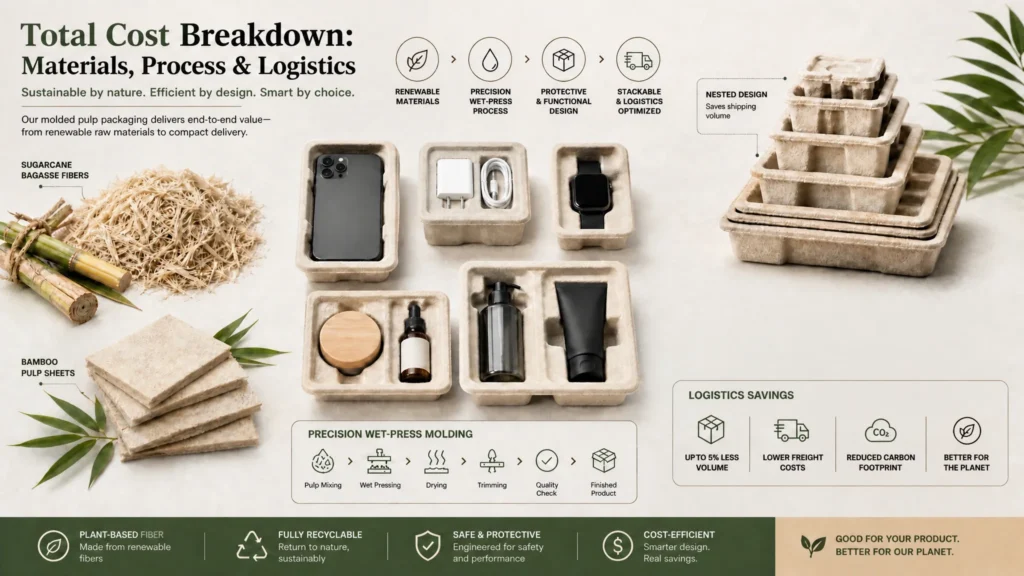
- Nested designs cut packed volume by roughly 50–70%, which is where most of the freight saving comes from.
- Uncoated grades are recyclable and industrially compostable when certified to EN 13432 or BPI; waterproof-coated grades are not.
- Tooling starts at US$2,400 and is quoted per drawing. MOQ is 1,000 pcs for wet-press and 5,000 pcs for dry-press per SKU; sampling takes 10–15 working days and production 15–20.
Specifications at a glance
These are our standard commercial terms for custom molded pulp trays, inserts and boxes. Every figure below is quoted per SKU, because cavity count and finishing move both the tool and the unit price. If you need the definition, the fibre grades and how the four processes differ, read what molded pulp packaging is first.
| Item | Our standard | What moves it |
|---|---|---|
| MOQ per SKU | 1,000 pcs wet-press 5,000 pcs dry-press |
Set by process, then by cavity count and finishing. Full MOQ and tooling breakdown |
| Tooling cost | From US$2,400, quoted per drawing | Cavity count, part size, tool material and tolerance class. We do not publish a price list because two drawings of the same footprint can differ by an order of magnitude |
| Sampling lead time | 10–15 working days | Counted from drawing approval; longer for multi-cavity, printed or coated items |
| Production lead time | 15–20 working days | Counted from sample approval; depends on quantity, cavity count and finishing |
| Wall thickness | Set per drawing | Wet-press holds a tighter cavity tolerance than dry-press at the same thickness |
| Formats | Open tray, insert, lid box | Wet-press, dry-press or thermoformed — see the process comparison below |
Molded pulp packaging is protective packaging made from recycled paper pulp, sugarcane bagasse or bamboo, formed on a mesh tool and dried into rigid trays, inserts and boxes. Buyers move to it for three reasons that can be checked rather than argued: it avoids plastic packaging taxes and single-use plastic restrictions, it cuts shipping volume through nesting, and it protects fragile goods without foam. Where foam, plastic or corrugated is still the better answer, our material comparison sets out which and why. What follows covers how the two main molding processes differ, what tooling and unit costs actually look like, which certifications buyers ask for, and how to specify a tray that survives a drop test.
What molded pulp tray, insert and box packaging is
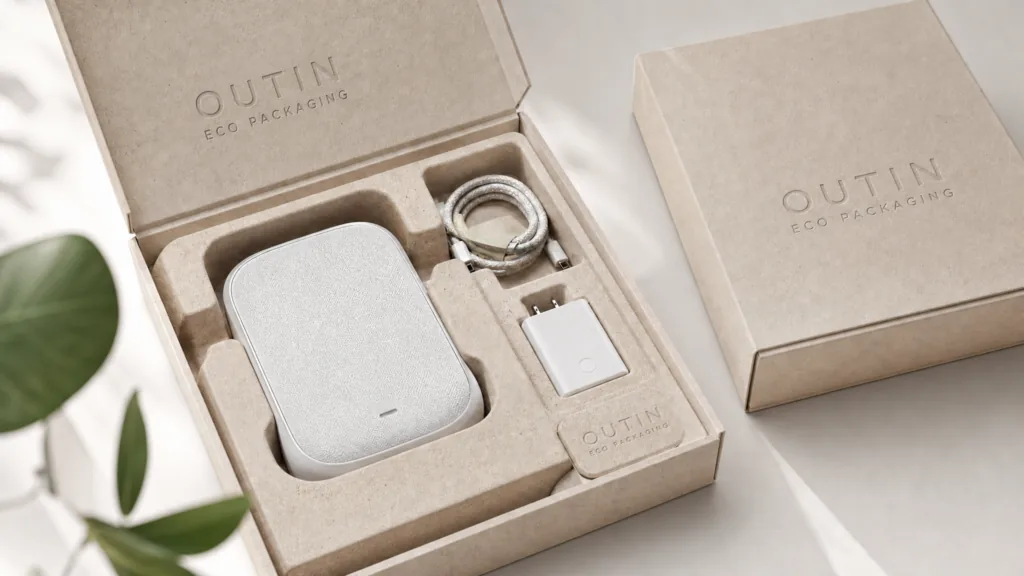
The material starts as a water-based fiber slurry. A vacuum-formed mesh tool picks up fiber, the wet shape is pressed and dried, and the result is a rigid three-dimensional shell that follows the contour of the product it carries. Three formats cover most molded pulp export programs: trays (open, single or multi-cavity), inserts (fit inside a folding carton or rigid box), and boxes (a tray with a hinged or separate lid).
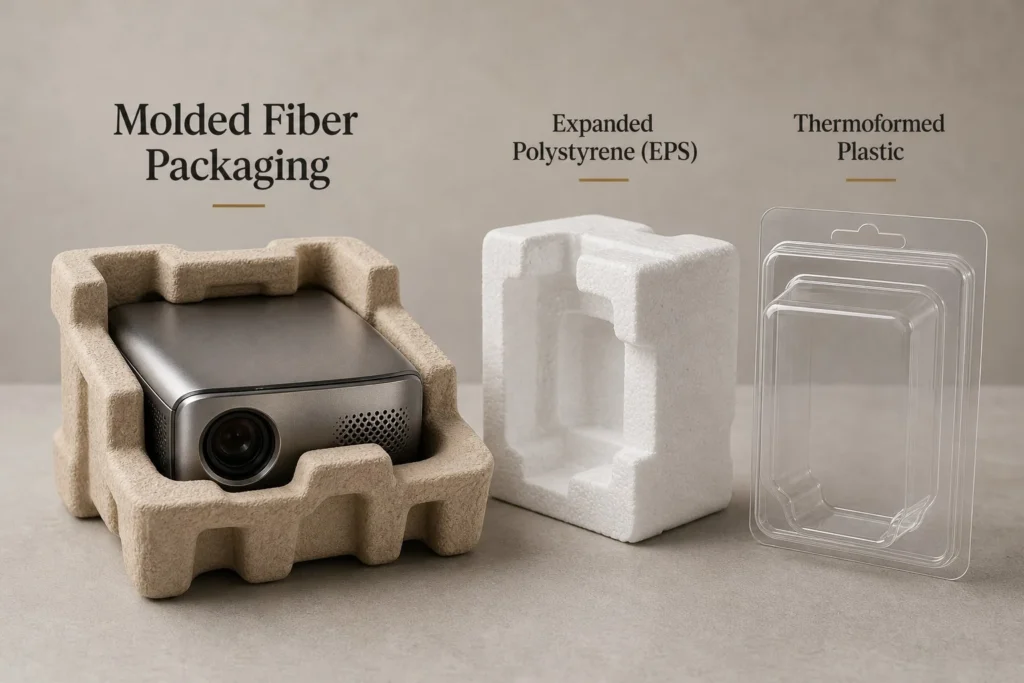
Wet-press, dry-press and thermoformed: pick by surface and tolerance
These are not marketing terms, they are different production routes with different economics — wall thickness 0.8–1.5 mm (wet-press) against 1–3 mm (dry-press), and MOQ 1,000 against 5,000. Full wet-press vs dry-press comparison, including cavity tolerance →
- Wet-press (thin-wall): pressed between heated matched tools while still wet. Smooth, dimensionally stable surfaces, tight cavity tolerance, higher tooling cost. This is the route for cosmetics, electronics and retail-facing gift packaging.
- Dry-press (thick-wall): formed wet, dried in open racks or a tunnel, pressed afterwards. Cheaper tooling, rougher surface, looser tolerance. Typical for egg trays, fruit trays and heavy industrial cushioning.
- Thermoformed fiber: a dried fiber board is re-formed under heat and pressure. The sharpest edges and best printability, the highest per-unit cost.
Ask a supplier which route they are quoting before comparing prices — a wet-press quote and a dry-press quote for the same drawing are not the same product.
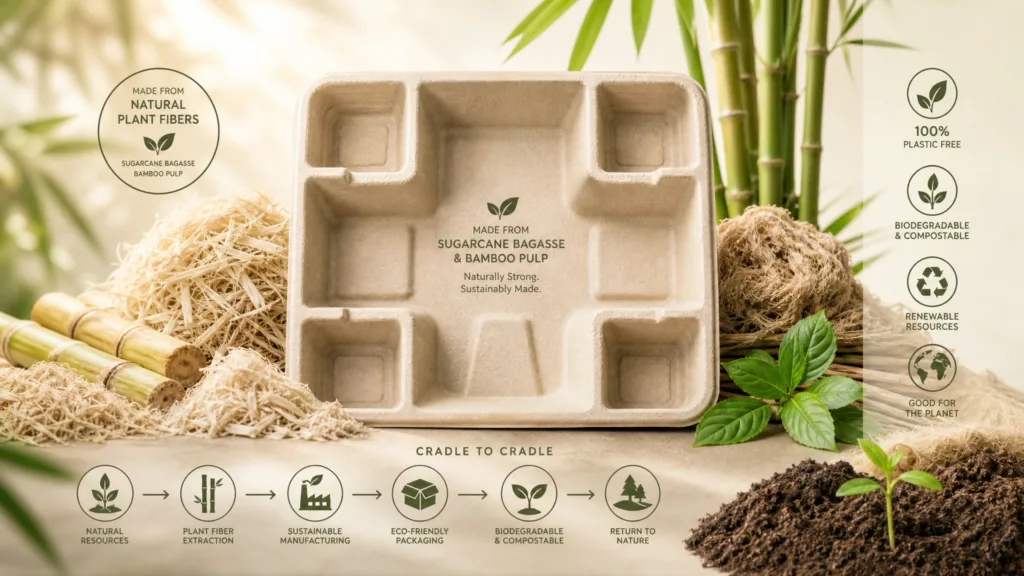
Why brands are switching: five drivers, in the order buyers rank them
1. Plastic regulation stopped being a future risk. The EU Single-Use Plastics Directive and the Packaging and Packaging Waste Regulation, the UK Plastic Packaging Tax, and a growing set of US state extended producer responsibility laws all put a cost or a restriction on polymer packaging. Fiber packaging sidesteps the plastic-tax line item entirely, because the tax is assessed on plastic components by weight.
2. Protected volume, not just protected product. A pulp insert is a structural shell: ribs, cavities and ledges absorb impact by deforming and by spreading load, instead of relying on material thickness the way foam does. The same geometry lets parts nest, so a pallet holds more units and a container carries less air.
3. Cost moves from material to tooling. Fiber feedstock is a fraction of the cost of polymer per tonne, but the saving only materialises after the tool is amortised. That is why the honest comparison is per unit at your annual volume, not per kilogram at the material level.
4. Customisation is geometric, not cosmetic. Cavity layout, draft, ribs, embossing and print are all set at tool design, so a single tool defines how the product sits, how it ships and how the unboxing reads.
5. Retail and ESG audits now ask for evidence. European retail chains and brand owners increasingly request fiber-based or certified compostable packaging from suppliers, together with documentation. A pulp program with certificates and test reports answers that question before it becomes an order blocker.
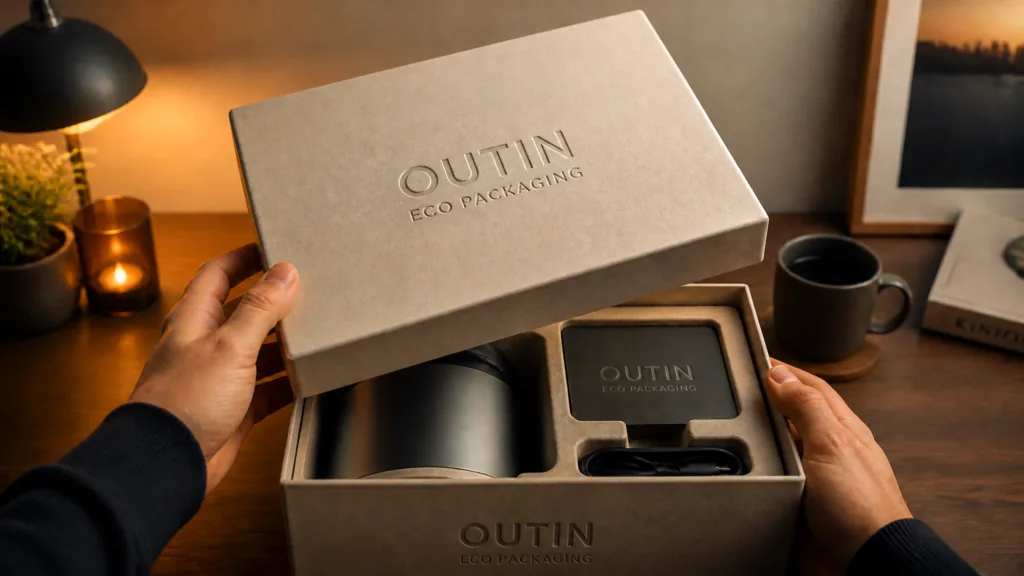
Pulp vs EPS foam vs EPE foam vs corrugated inserts
Choosing between molded pulp and foam is not a straight cost or sustainability call. The comparison that matters is at the specification level.
| Criterion | Molded pulp | EPS foam | EPE foam | Corrugated insert |
|---|---|---|---|---|
| Feedstock | Recycled paper, bagasse, bamboo | Petroleum-based polystyrene | Petroleum-based polyethylene | Wood pulp board |
| End of life | Recyclable; industrially compostable when certified (EN 13432 / BPI) | Rarely recycled; banned or restricted in several markets | Rarely recycled | Recyclable, not compostable |
| Typical wall | 1–5 mm, set by tool | 20–50 mm | 10–30 mm | 3–7 mm board |
| Cushioning mechanism | Structural ribs and cavities plus fiber compression | Material compression | Material compression | Folded structure |
| Packed volume | Nests; up to 50–70% less than foam | Bulky, does not nest | Moderate | Ships flat |
| Upfront cost | Tool required | Tool required | Tool or die cut | Die only, lowest |
| Plastic tax exposure | None (no plastic component) | Charged by weight | Charged by weight | None |
How to read this table: for a heavy, low-value part with loose tolerance, corrugated or dry-press wins on cost. For a fragile, retail-facing part where packed volume drives freight, wet-press pulp usually wins once tooling is amortised — and it removes a tax line that foam cannot.

What it actually costs, and how to calculate it
Published per-kilogram feedstock prices mislead, because packaging cost is driven by grams per unit and by tool amortisation. Calculate it in four lines:
- Material per unit = unit weight in grams × pulp price per kg ÷ 1,000. Pulp is quoted per tonne; ask for the grade (bagasse, recycled newsprint, mixed) because price and surface quality differ.
- Tooling amortisation = tool cost ÷ order quantity. A single-cavity tool on a simple tray and a multi-cavity hardened tool on a thin-wall cosmetic insert are orders of magnitude apart. Ask for the tool cost against your specific drawing, not a range.
- Conversion = forming, pressing, drying, trimming, and any finishing (printing, coating, embossing).
- Freight and storage = packed volume × freight rate, plus warehousing. This is where nesting pays back: a 50% volume reduction cuts ocean freight roughly proportionally on volumetric cargo.
Run those four lines for molded pulp and for EPS at your real annual quantity before deciding. At low volume the tool dominates and foam looks cheaper; above the crossover point the fiber unit price and the removed plastic tax usually close the gap. A supplier who quotes a per-unit price without stating the quantity it assumes has not quoted anything you can compare.
On tooling and MOQ specifically: tooling starts at US$2,400 for a multi-cavity thin-wall tool and is quoted against your drawing rather than from a price list, because cavity count, part size, tool material and tolerance class each move it. MOQ is 1,000 pcs for wet-press and 5,000 pcs for dry-press per SKU. The tool is charged on the first order only; repeat orders carry no tooling fee as long as the design is unchanged. Full cost, tooling and MOQ breakdown →
Two cost traps worth checking in any quotation: moisture content (fiber is sold with a moisture allowance — a wet quote is not a cheaper quote) and tolerance class (a drawing with ±1 mm cavity tolerance and one with ±3 mm are priced differently).
Compliance: the four questions buyers actually ask
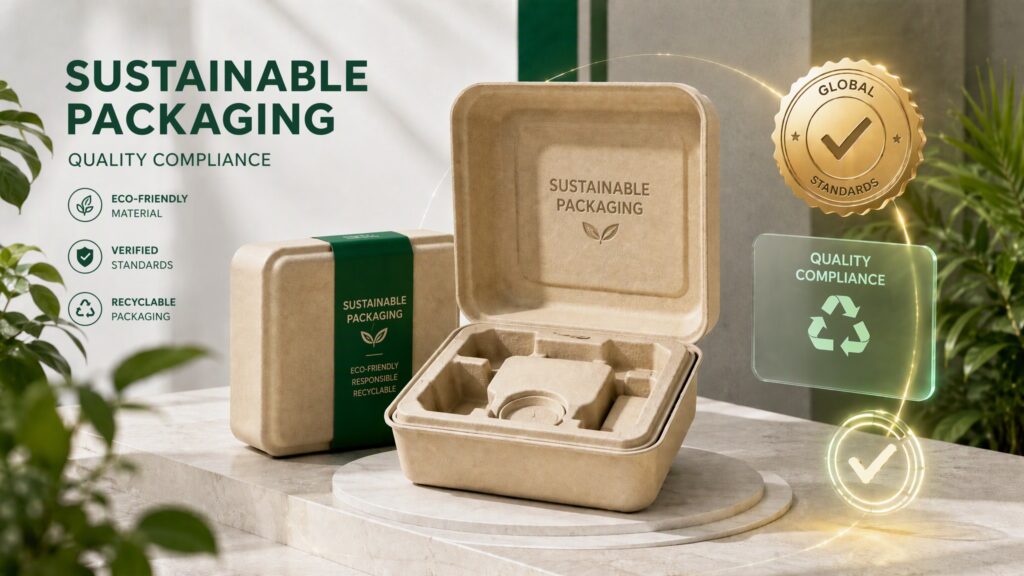
Fiber packaging is not automatically compliant — compliance comes from the grade, the coating and the documentation. Expect these four questions.
For the document-by-document version — which standard proves what, what to request in an RFQ, and where a certificate number actually exists — see molded pulp packaging certifications and test standards.
- "Is it plastic-free?" Uncoated molded pulp is. A waterproof or grease-barrier coating can introduce a polymer layer, so ask what the coating is and whether the finished item still qualifies as plastic-free in your destination market. The EU single-use plastics rules are the reference point for the EU.
- "Is it compostable, and certified by whom?" Industrial compostability is certified to EN 13432 (EU) or by BPI (US). Home compostability is a separate certification. A supplier who says "biodegradable" without a certificate number has not answered the question. Standards are published by CEN.
- "What about the UK Plastic Packaging Tax?" The tax is assessed on plastic packaging components by weight, so an all-fiber pack is outside its scope — but any plastic window, laminate or coating counts. Document the component breakdown.
- "Can you prove protection with a test?" Ask for a drop and vibration protocol, not an adjective. ISTA 3A is the usual reference for parcel distribution.
Protection: how the structure absorbs impact
Foam absorbs energy by compressing a thick, low-density material. A pulp tray does it with geometry: the part sits in a cavity bounded by ribs, and those ribs are designed to crush or buckle in a controlled way, spreading the load over a larger area and keeping the product away from the box wall.
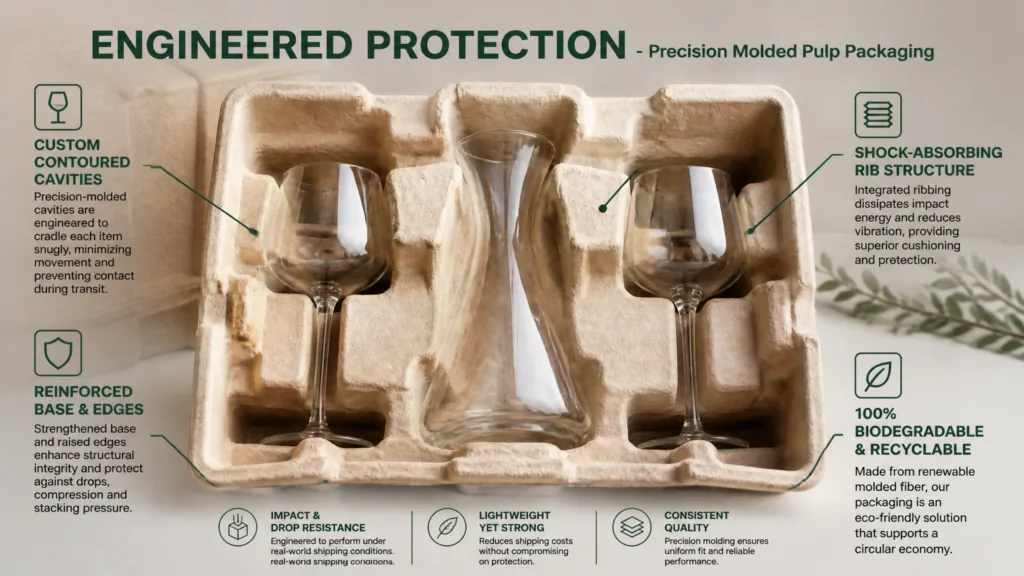
Three specification points decide whether it works in the field:
- Contact area. The product should touch the tray on defined ledges, not on its most fragile surface. Glass and cosmetic surfaces need clearance, not pressure.
- Wall thickness and draft. Thin walls save material but reduce crush resistance; insufficient draft makes parts stick and slows the line.
- Test protocol. A drop test to a defined height, on a defined face, with the product in its retail pack, is the only evidence worth quoting.
What to ask for instead of a percentage: the protocol. Which faces were dropped, from what height, with the product in its retail pack, and what changed between the failed and the passed iteration. A damage-rate figure without the protocol behind it is not evidence — it is a claim. We send the test report for a comparable SKU with the quotation.
What you can specify
A molded pulp tool is fixed once cut, so the specification conversation happens before tooling, not after sampling.
- Wall thickness and grammage: set per drawing. Wet-press holds a tighter cavity tolerance than dry-press, and tolerance class moves the price more than thickness does — so specify the tolerance you actually need.
- Surface: natural kraft, bleached white, color-dyed pulp, or printed and embossed branding. Customization options are set at tool design.
- Functional treatments: waterproof or grease-resistant coating, and anti-static pulp for electronics. Note the trade-off: a coating improves moisture resistance and can remove compostability.
- Format: open tray, insert for a folding carton, or a molded pulp gift box with hinged or separate lid.
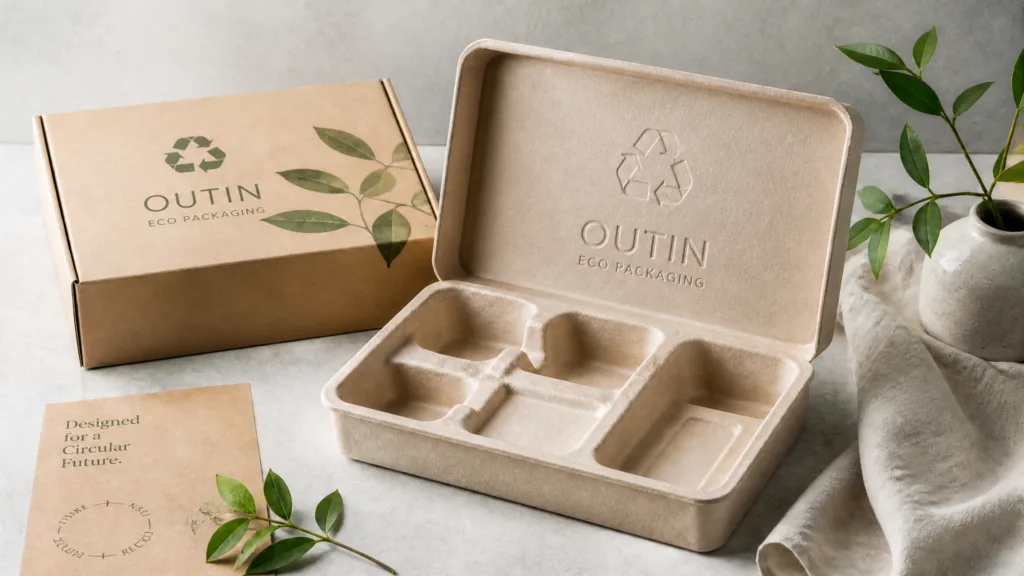
Applications by industry
The molded pulp tray geometry changes completely between these five groups, which is why an off-the-shelf tray rarely fits a new product.
- Electronics: anti-static pulp, precision cavities for devices and accessories — molded pulp trays for electronics.
- Skincare and cosmetics: thin-wall wet-press, smooth surface, retail-ready finish — trays for skincare and cosmetics.
- Glassware and ceramics: deep contoured cavities with rib reinforcement for breakage-prone items.
- Shipping and logistics: high-nest designs for volumetric freight saving — trays for shipping.
- Agriculture and fresh produce: breathable dry-press trays for fruit and eggs — pulp packaging for agriculture.

How to choose a supplier: eight questions
Most failed pulp projects fail at supplier selection, not at the material. Ask these before paying a tool deposit.
- Which process are you quoting — wet-press, dry-press or thermoformed?
- What is the tool cost for this exact drawing, and who owns the tool?
- What is your MOQ per SKU, and how does unit price step down?
- Sampling lead time and production lead time, separately. (Ours: 10–15 working days sampling, 15–20 working days production.)
- Which certificates do you hold — ISO 9001, FSC, BPI or EN 13432 test reports? Ask for numbers, not logos.
- What is the cavity tolerance you can hold, and how do you inspect it?
- Can you run the drop test with our product and send the report?
- What happens if the first batch fails dimensional inspection?
Then verify the answers against the production process and how we work — a supplier who cannot walk you through forming, drying and trimming in order is reselling, not molding.
Molded pulp packaging FAQ
Is molded pulp packaging waterproof?
Uncoated pulp absorbs moisture. Food-grade waterproof and grease-resistant coatings are available for humid ocean freight and long storage, but a coated grade is generally no longer compostable, so specify which property matters more for your market.
Will it survive long-distance ocean and air freight?
Yes, when the cavity is designed for the drop height and stacking load of that route. Protection comes from rib geometry and clearance, not from wall thickness alone. Ask for a drop test on the packed retail unit.
How long does customization take?
Sampling runs 10–15 working days from drawing approval and production runs 15–20 working days from sample approval. Multi-cavity, printed or coated items sit at the upper end of both ranges.
Is molded pulp actually compostable?
Uncoated pulp is biodegradable, and industrial compostability is certified to EN 13432 in the EU or by BPI in the US. Home compostability requires a separate certification. Ask for the certificate number and the covered grade.
Molded pulp or EPS foam — which protects better?
Neither wins in general. EPS is efficient for heavy, simple shapes at low tooling cost. Molded pulp is competitive, and usually better on packed volume and compliance, for fragile parts that need defined positioning. Decide on a drop test, not on a datasheet.
What is the MOQ and how much is the tooling?
MOQ is 1,000 pcs for wet-press and 5,000 pcs for dry-press per SKU. Tooling starts at US$2,400 for a multi-cavity thin-wall tool and is quoted per drawing, because cavity count, part size, tool material and tolerance class drive it. Tooling is charged on the first order only — repeat orders carry no tooling fee. Send a 3D file or a sample and we return a tool price plus the unit price at 1k, 5k and 10k units.
What wall thickness and tolerance can you mold?
It depends on the process. Wet-press holds a tighter cavity tolerance than dry-press, and tolerance class affects price more than thickness does. Send a drawing and we return the achievable range for that geometry.
Does it comply with EU and UK packaging rules?
An all-fiber pack contains no plastic component, so it falls outside plastic packaging taxes and single-use plastic restrictions. Any plastic window, laminate or coating must be declared. We supply a component and material breakdown with each quotation — see our certifications and test standards and the FAQ page.
Next step
The fastest way to price a molded pulp switch is to send one product. Share a 3D file or a physical sample with its packed weight and target carton count, and we return a tool quote, a per-unit price curve, and a drop-test plan for that specific part.