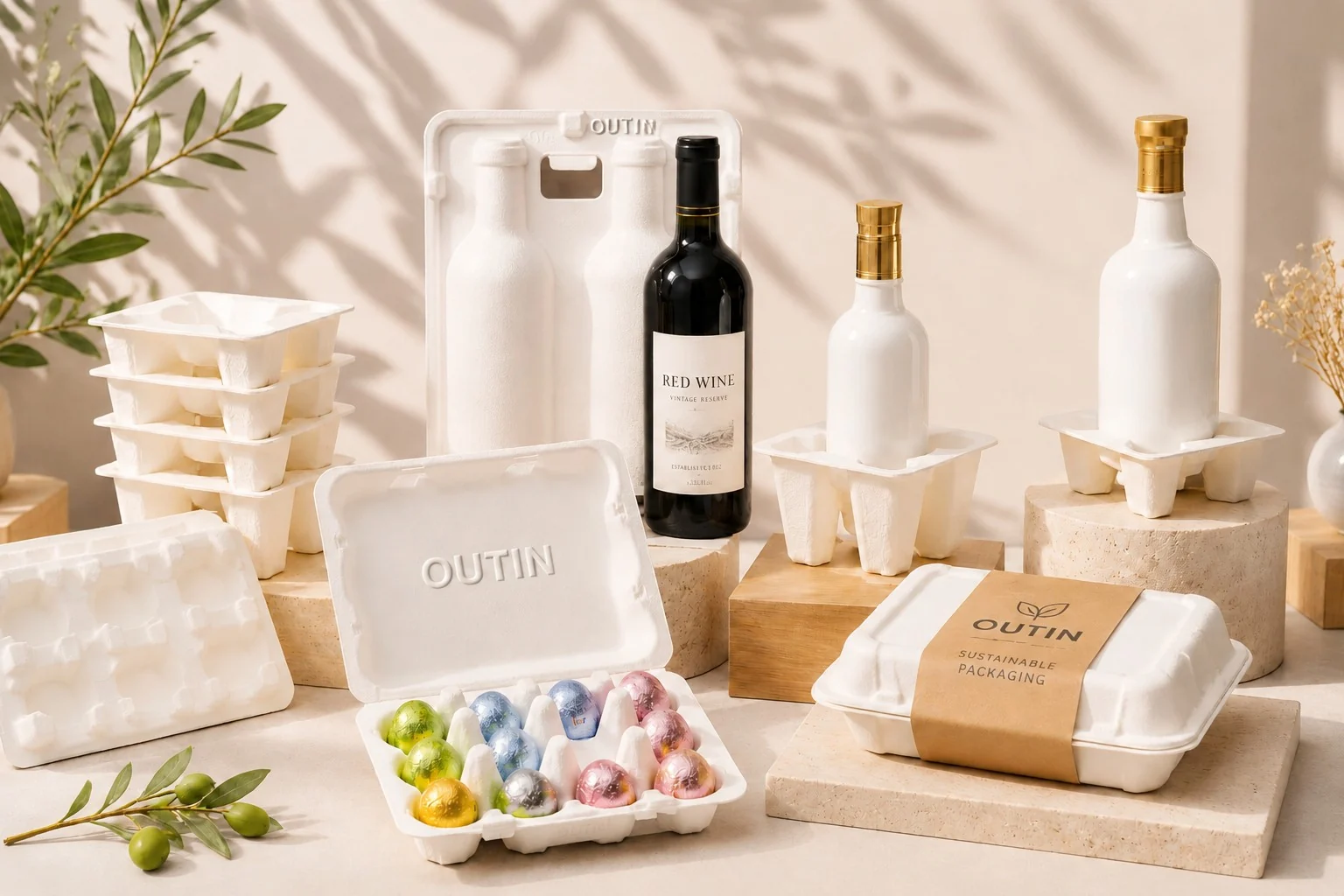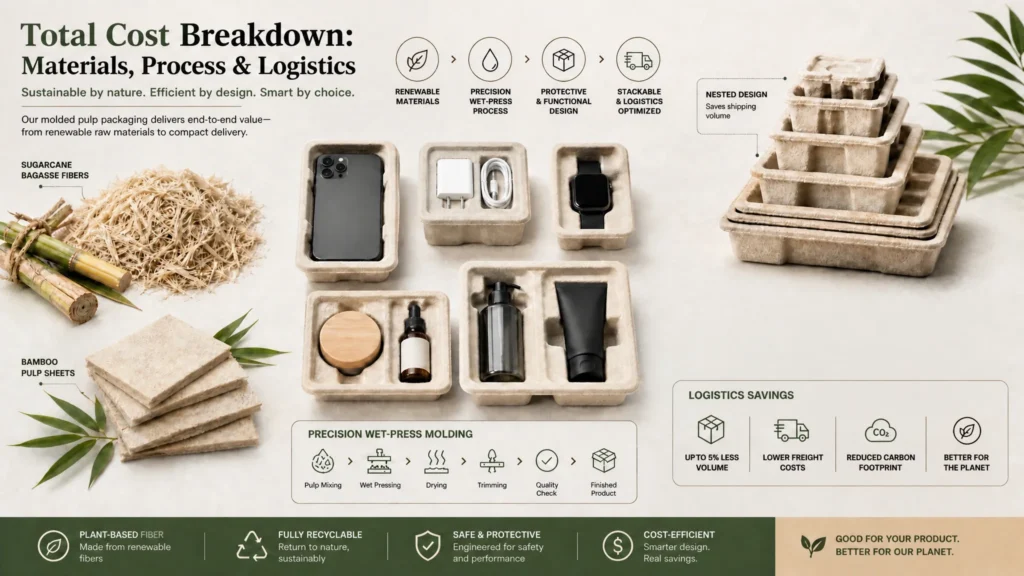
Food, beverage and alcohol is the hardest test for molded pulp, because the insert has to do three jobs at once: hold a glass bottle or a portion where it belongs, take the drop, and stay clean enough to sit next to something people eat or drink. This guide covers how the format is chosen, where the tolerances come from, and the documents a retailer will ask for before the first order.
What molded pulp does in a food pack
Three jobs, and it is worth separating them because they pull in different directions. Locate: the cavity is drawn from the product, so the item is held at the base and, where it matters, at the shoulder. Cushion: a fibre wall of 1–3 mm deforms and recovers, which is what turns a drop into a deceleration instead of a point load. Present: the pack is often opened in front of a customer, so the face has to survive being looked at — which is why white wet-press grades exist at all.
A fourth job gets less attention: venting and drainage. Pulp is porous, so a chilled bottle does not sweat into a puddle inside the pack the way it does against a plastic tray. For dairy and chilled drinks that is a real advantage, not a marketing line.
Wet-press or dry-press: the first decision
Every other choice follows this one. Wet-press gives a wall of 0.8–1.5 mm and cavity tolerance of ±0.03–0.05 mm, with a face smooth enough to print on and tight enough that a lid seats flush. It is the right answer when the pack is seen before it is opened. Dry-press runs 1–3 mm at ±0.08–0.15 mm, has a matte natural face, and costs less per part and per tool; it is the right answer when the tray only has to locate and protect.
The two are not interchangeable at the extremes. A six-cell wine tray that ships inside a corrugated case is a dry-press part; the same tray sold as a gift box insert is usually wet-press, because the customer sees it. The wet-press and dry-press comparison sets thickness, tolerance, MOQ and tooling side by side.
Dry fill and wet fill ask for different things
Dry goods — rice, coffee capsules, tea, eggs — need no barrier at all. The pulp is the pack, and the only questions are cavity fit and compression. Wet fill is different: a glass bottle of liquid brings two problems, mass and movement. Mass means the pocket has to hold the base properly and the tray has to be deep enough that the centre of gravity stays inside the footprint. Movement means the bottle must not be able to rise: a base pocket alone allows vertical play, which is why the usual build pairs the tray with a top pad or a matched upper half.
Where a barrier is genuinely required — oily dressings, acidic fill, long ambient storage — it is specified as a separate decision rather than assumed into the pulp. Sometimes that is a coated grade, sometimes a bag inside the pulp shell, sometimes a different format. Saying so early avoids the most common failure in this category: a paper pack that had to be wrapped in plastic to work.
Format by product type
| Product | Format that works | Why |
|---|---|---|
| Eggs, chocolate eggs | Hinged 6 or 12-cell box, waist band | Hinge and cells are one part; the band holds it shut without tape. 12-cell example. |
| Coffee capsules | Flip-top box with capsule cavities | Retail-facing, opens and re-closes; band carries variety. Coffee pod box. |
| Yoghurt, dairy cups | 4-pack box or matched upper/lower inserts | Cups are tapered, so the cavity has to follow the taper. Yoghurt box, matched inserts. |
| Rice and grains | Portion pods in a tray, banded, in a rigid box | Portioning protects aroma; the band carries net weight. Rice gift set. |
| Wine and spirits | 6-cell tray, clamshell, or tray + pad + carton | Glass needs the base held and the closure pressed. 6-cell tray, complete shipper. |
| Craft drinks, kombucha | Nested upper/lower trays, column stacking | Bulk cases stack without the top layer pressing on caps. Nested trays. |
| Liquid gift formats | Wet-press multi-cavity gift box | Visible face, tight cavities, no foam insert. Baby bottle gift box. |
Cavity tolerance is what holds the bottle
A bottle drawing has three diameters that matter: the body, the shoulder, and the closure. A cavity cut to the nominal body diameter will either grip and mark the glass or rattle, depending on which side of the tolerance that particular bottle falls. This is why a pulp mould is drawn for one bottle rather than a range, and why ±0.08–0.15 mm (dry) versus ±0.03–0.05 mm (wet) is a real functional difference and not a spec-sheet decoration.
For a family of SKUs there are two honest routes: one tray outline with different cavity depths, or one cavity with different top pads. Both work when the body diameter is shared. Neither works when the diameters differ by more than a couple of millimetres, and a supplier who says otherwise is quoting you a rattle.
Food-contact paperwork, in plain terms
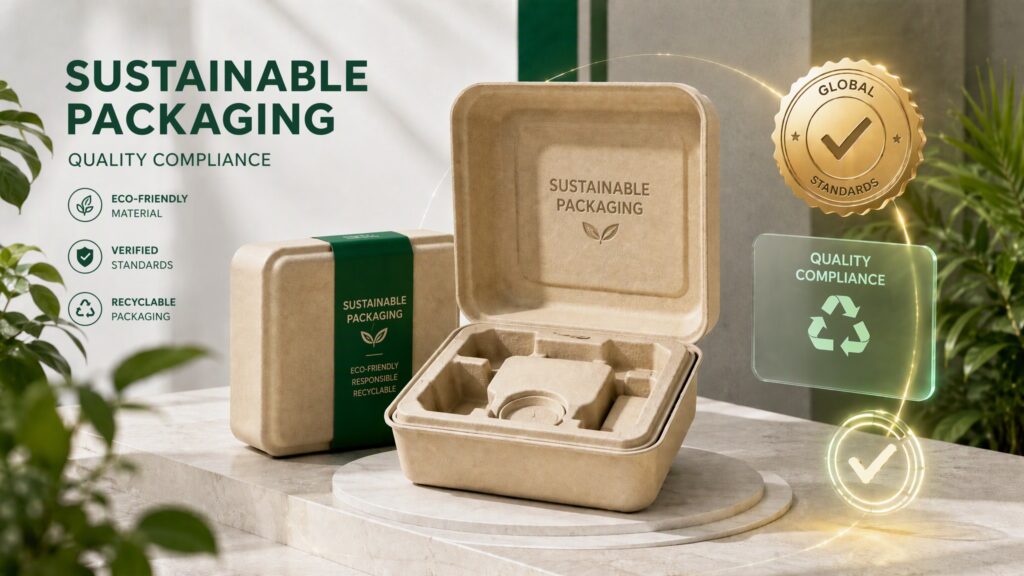
What a converter can actually issue is a declaration about a defined grade: FDA status for the paper components under 21 CFR 176.170 and 176.180, and a restricted-substance declaration in RoHS format. What a converter cannot issue is a certificate that the regulation behind it belongs to. PPWR (EU 2025/40) is the clearest example — it applies to the packaging you put on the market, covering recyclability, recycled content over time and labelling, and no supplier holds it as a certificate.
Practical consequence: when a retailer asks for “PPWR compliance”, the answer is a document pack — material declarations, a component count, recyclability of each component, and where the labelling will sit. The certifications and test standards guide lists what each document covers so you can map it to the retailer’s checklist rather than sending everything and hoping.
MOQ, tooling and why a second cavity costs what it does
Minimums follow the process: 5,000 pcs dry-press, 10,000 pcs wet-press. Tooling starts at US$2,400 per pulp tool, and a set is rarely one tool — a tray, a lid and a pad are separate drawings, each with its own cavity. Sampling runs 10–15 working days and production 15–20 working days after approval, which means the tooling decision is the schedule decision.
The arithmetic that surprises buyers is the second size. A 500 g rice pod and a 1 kg pod are not a resize; they are two tools, two sampling rounds and two approvals. That is why ranges are built around one fill weight first and extended after the first reorder — and why the cost and tooling breakdown is worth reading before the artwork is finalised.
Transit: compression, humidity and the drop test
Three failures dominate. Compression: the bottom case carries the stack, so the tray’s walls and the carton’s flute grade are chosen together, not separately. Humidity: fibre takes up moisture and a damp wall is a weaker wall, so a route through a humid corridor is a specification item — wrap, bag, desiccant, container choice. Impact: the pack that matters is the assembled one. A tray tested empty proves nothing; the test is ISTA 3A on tray, product and carton together.
If the pack is also a retail unit, add a fourth: repeated opening. A hinged box or a banded pod that has been opened and re-closed in a shop is a different structure from one that was sealed once.
Six questions to send with your drawing
- Fill weight and, for grains, bulk density — 500 g of long grain and 500 g of short grain are different cavities.
- The container drawing with the three diameters: body, shoulder, closure.
- Units per carton and the stacking height in your warehouse.
- Closure type — crown cap, screw, swing-top — because the pad is drawn to it.
- Channel: shelf, parcel, or both. A parcel pack needs the closure pressed; a shelf pack needs a face.
- The documents your retailer asks for, by name, so the declaration pack matches the checklist.
Frequently asked questions
Is molded pulp food-contact safe?
The pulp is formed from plant fibre and we issue a status declaration for the paper components under 21 CFR 176.170 and 176.180, plus a restricted-substance declaration in RoHS format, for a defined grade. That is a declaration about a grade, not a certificate held by the converter. If the fill is oily, wet or acidic, the barrier question is settled separately — sometimes by a liner, sometimes by choosing a different format altogether.
Can a pulp tray hold a glass bottle tightly enough for parcel shipping?
Yes, if the pocket follows the bottle rather than a nominal cylinder, and if something stops vertical movement. A single tray locates the base; it does not hold the bottle down. The usual build adds a top pad that presses on the shoulder or closure, then a corrugated carton whose internal height is set from the tray footprint plus that pad. That is the arrangement in our six-bottle wine and spirits pack.
Does humidity affect molded pulp in sea freight?
Fibre takes up moisture, and a damp wall is a weaker wall. Two things follow: the pack is specified for the container it travels in rather than for a dry sample room, and where a route is long and humid the pulp is wrapped or bagged and the container is treated as part of the design. It is a solvable problem, but it is a specification item, not an afterthought.
What is the minimum order quantity?
5,000 pcs for dry-press parts and 10,000 pcs for wet-press parts. Both are custom-formed from a tool cut to your drawing, so there is no stock-mould route at a thousand pieces. A second cavity size is a second tool, which is why ranges are usually built around one bottle or one fill weight first.
Can the pack be printed, or only the carton?
Print on paper parts is cheap to change per release: the band, the sleeve, the carton, the rigid box wrap. Print on the pulp itself is possible but changes the surface, so most brands deboss the pulp and put the variable information — variety, weight, origin — on the band. The rice gift set works exactly that way.
Is PPWR a certification?
No. PPWR (EU 2025/40) is a regulation that applies to the packaging you place on the market — recyclability, recycled content over time, labelling. No supplier can hold it as a certificate. What a supplier can give you is material and substance declarations and a component count you can defend; the certifications guide sets out which document covers what.
Send a drawing
Send the bottle or portion drawing, the fill weight, the units per carton and the route. We will come back with a cavity drawing, the wall thickness the load asks for, the pad or upper half if the pack needs one, and the declaration pack your retailer wants — before a tool is cut. Sampling runs 10–15 working days; production 15–20 working days after approval.
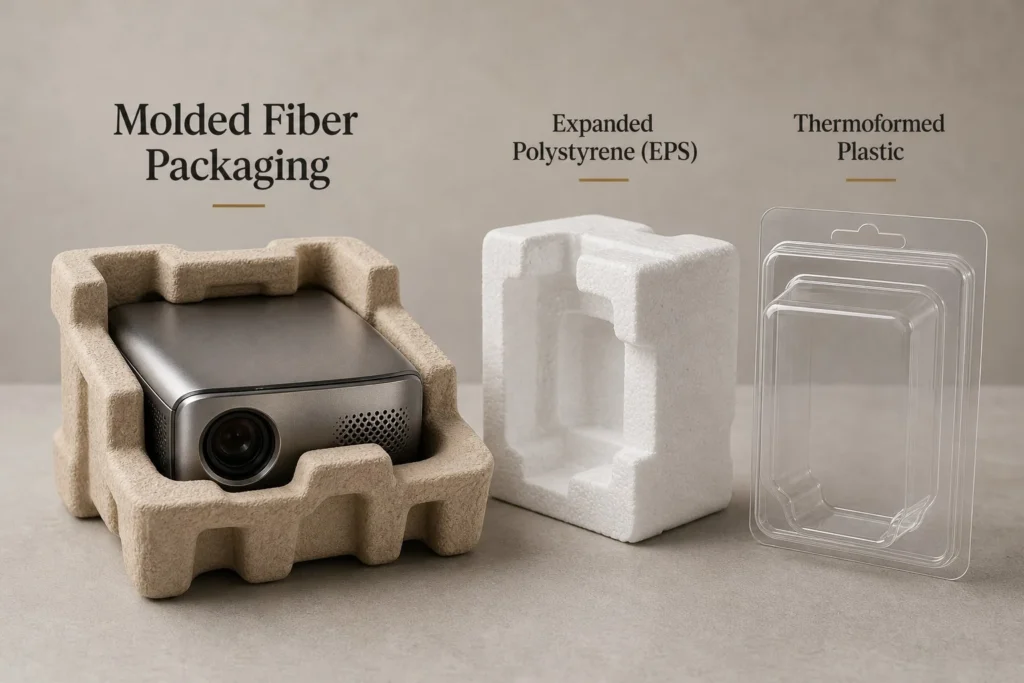
The full food, beverage and alcohol range is here, and if the pack needs an outer carton, a rigid box or a band quoted as one matched set, that is the integrated packaging range. New to the material? Start with what molded pulp packaging is, or see why brands switch from foam and plastic inserts.