

Product Overview
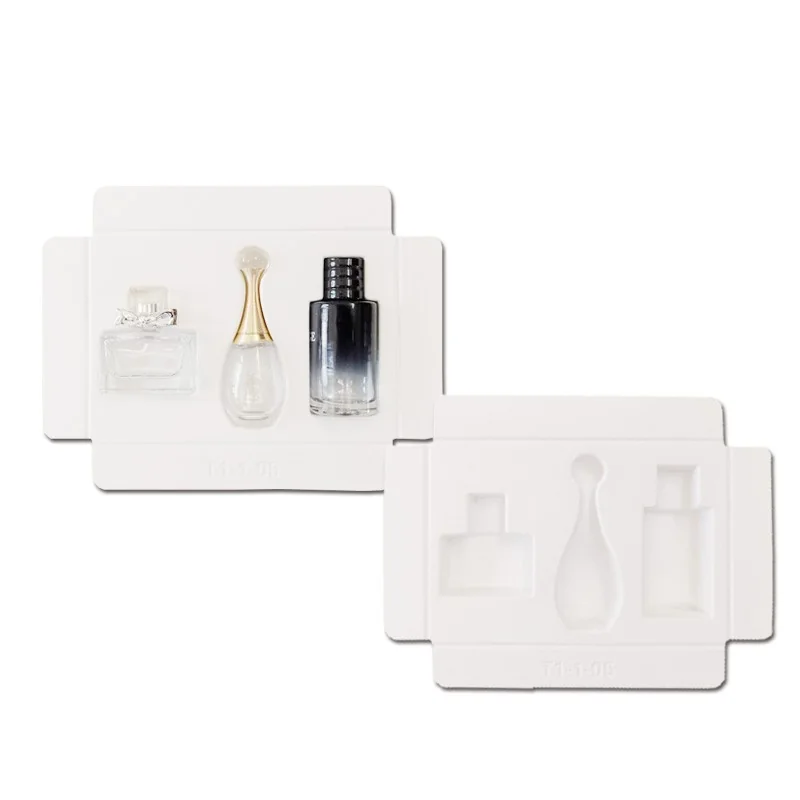
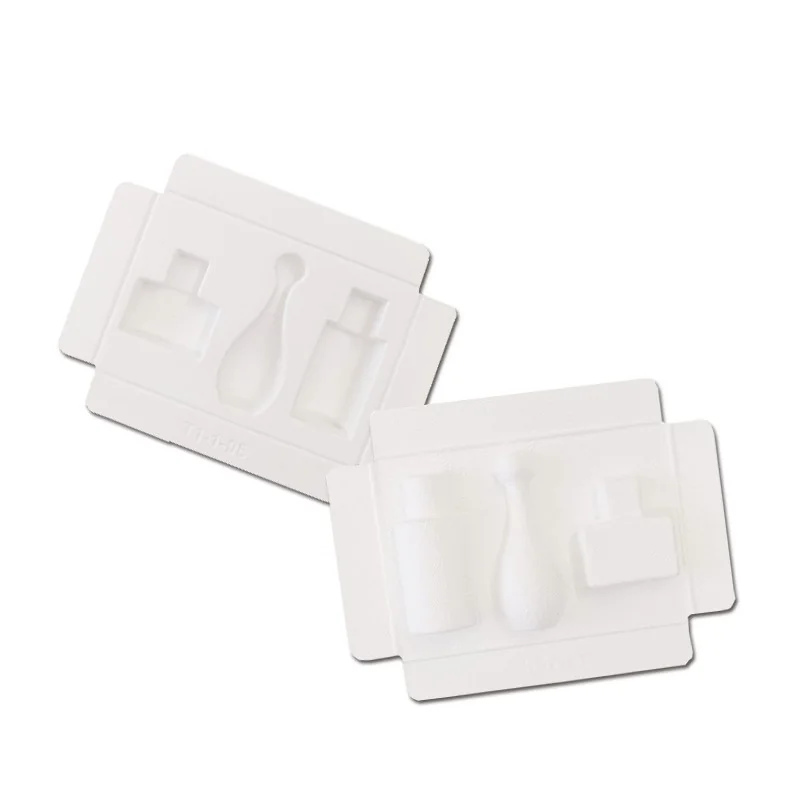
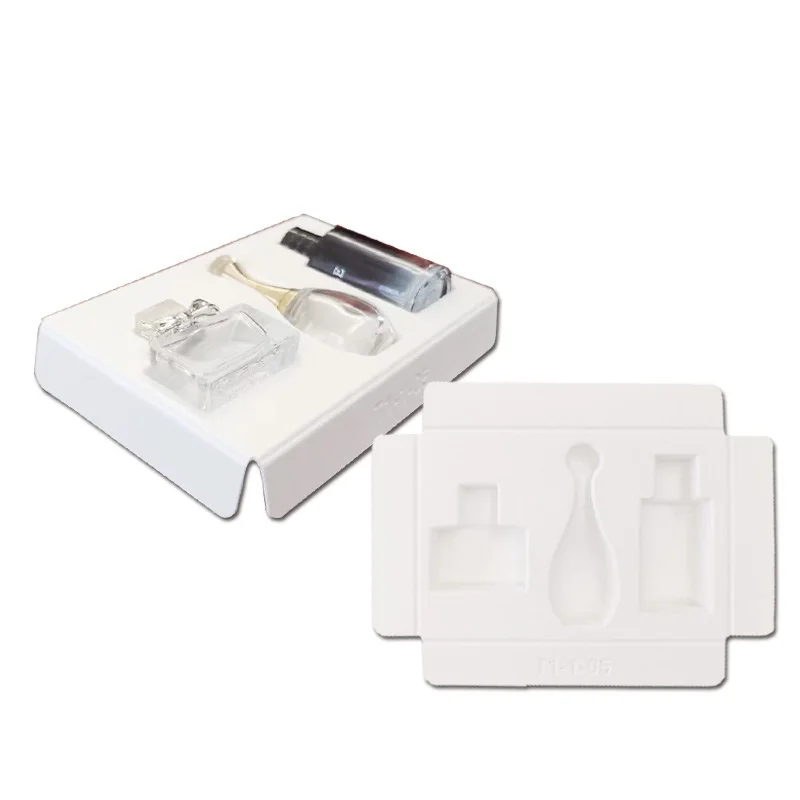
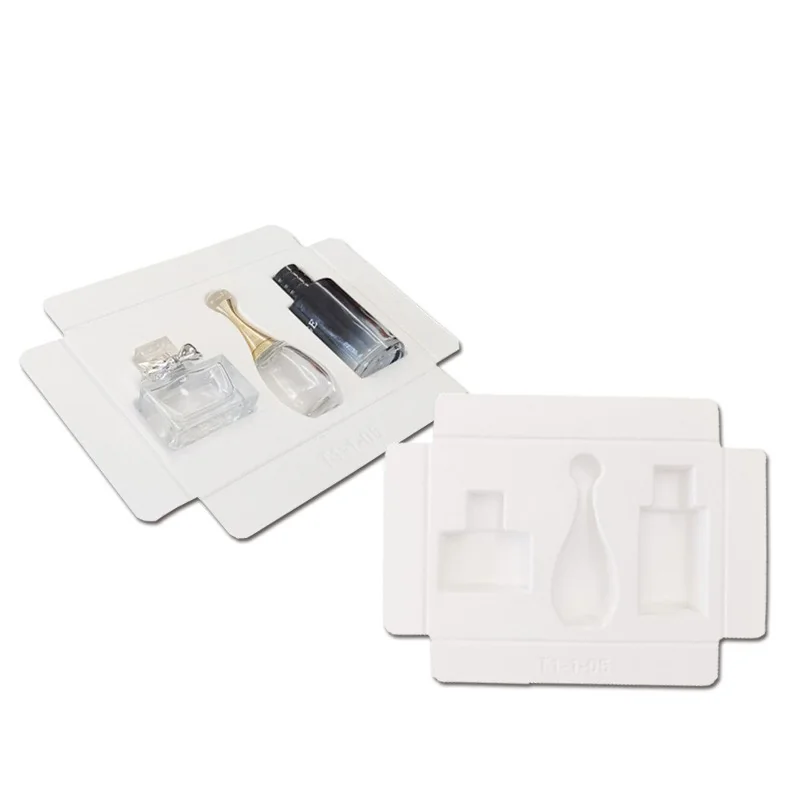
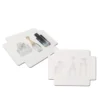
This molded pulp cosmetic bottle insert is a single card, wet-pressed in white fibre, with three formed cavities that locate a fragrance or skincare set inside its retail box. The sample carries a square flacon, a teardrop bottle and a tall rectangular bottle in one line, each sitting in its own pocket rather than in a shared well — so the three components cannot touch, rotate or settle against each other in transit.
The card folds up at two side tabs, which stand into the base of the outer box and hold the insert clear of the walls. That is the difference between an insert that fills space and one that positions a product: the tabs take the vertical load, the cavities take the lateral movement, and the set arrives in the arrangement the brand shot for its packaging. Dimensions follow your drawings — the bottles in the photographs are the set the sample tool was built around. If the brief could still go either way between fibre and plastic, how fibre and thermoformed trays compare for cosmetics sets out the tolerance, MOQ and export differences. If the set needs a closed box rather than a card, a five-vial box with a printed belly band does the same locating job behind a lid.
Key Product Features
- Three cavities in one forming — a square flacon, a teardrop bottle and a tall rectangular bottle are located by a single part, so the set is packed by placing components rather than by building up layers of foam.
- Folding side tabs — two formed fold lines turn the card into a self-supporting insert that sits square in the box instead of sliding inside it.
- Wet-press white face — the display side is pressed smooth at 0.8–1.5 mm, which is the finish that photographs cleanly under retail lighting and takes a deboss without tearing.
- Debossed branding — the sample carries a debossed mark in the lower right; the logo is pressed into the fibre as it forms rather than printed onto it.
- One material throughout — card, tabs and cavities are the same white fibre, with no foam, EVA, flocking or film to separate at end of life.
- Nests flat for freight — the cards stack and ship flat, so a carton carries more inserts than the equivalent foam build and the warehouse needs no assembly jig.
Fragrance and Cosmetic Set Scenarios
| Product packed | Why this format fits |
|---|---|
| Three-bottle fragrance gift set | The three pockets match the set as it is sold, so the box opens onto the arrangement the brand photographed. |
| Travel retail and sampling kits | One card holds mixed formats — flacon, teardrop, rectangular — without needing a different insert per component. |
| E-commerce and parcel inserts | The folded tabs hold the insert square inside the mailer, so components stay put after handling and the pack photographs well on unboxing. |
| Beauty subscription and routine boxes | The layout is drawn from the component list, so one tool serves every variant in a recurring programme. |
Material & Eco Advantages
Wet-press white fibre at 0.8–1.5 mm gives a smooth display face with a matt, paper-like hand. The insert is one material throughout: no foam block, no EVA, no flocked plastic shell and no laminated film, so the pack separates into the paper stream without a knife or a debonding step. For a fragrance set that matters, because the usual build is a rigid box with a foam or EVA insert, and that combination is the hardest part of the pack for a recycler to handle.
Food-contact and restricted-substance declarations are available on request: an FDA declaration under 21 CFR 176.170 and 176.180 for the paper components, and a restricted-substance declaration in a RoHS format. These are declarations of compliance for a defined grade rather than certificates held by the converter. PPWR (EU 2025/40) is a regulation that applies to the packaging you place on the market — recyclability, recycled content over time, labelling — not a certification a supplier can hold.
Product Specifications
| Material | Molded plant fibre, white finish (grade confirmed per project) |
| Structure | Single folding insert card with two formed side tabs; three cavities |
| Cavity | Three pockets — square flacon, teardrop bottle, tall rectangular bottle; sized to your component drawings (sample set shown) |
| Process | Wet-press, 0.8–1.5 mm wall for a smooth display face |
| Cavity tolerance | Wet-press cavity ±0.03–0.05 mm, precision cavity ±0.02 mm |
| Dimensions | Custom — set at the tooling stage from your bottle and box drawings |
| Branding | Debossed mark (sample carries a debossed word mark in the lower right) |
| MOQ | 10,000 pcs wet-press; a thicker dry-press version (1–3 mm) runs from 5,000 pcs. Custom-formed, so no stock-mould route at 1,000 pcs |
| Tooling | From US$2,400, quoted per drawing; paid on the first order, no charge on repeat orders. See the cost and tooling breakdown. |
| Sampling | 10–15 working days |
| Production lead time | 15–20 working days after sample approval |
| Terms | EXW, FOB, CIF or DDU |
Suitable Purchaser Groups
- Fragrance houses launching a signature set — one card holds the whole line-up, so the tool covers the set rather than one component at a time.
- Brands replacing foam or EVA inserts — the cavities do the job the foam did, in one material that goes into the paper stream.
- Travel retail and gift programmes — debossing plus white fibre carries the brand without printing directly on the pack.
- Brands already running molded pulp trays — the five-cavity set tray and the windowed perfume pack share the same tooling approach.
Frequently Asked Questions
Can the cavity layout be changed?
Yes. The cavities are cut into the forming tool, so the number, arrangement and profile of the pockets are fixed at the tooling stage from your component drawings. Moving a pocket after the tool is cut means a new tool, which is why the layout is signed off on a drawing rather than on a sample alone.
Will it hold bottles other than the three shown?
Yes. Each pocket is drawn from the component it carries, so diameter, height and shoulder position follow your bottles. The three in the photographs — a square flacon, a teardrop bottle and a tall rectangular bottle — are the set the sample tool was built around.
Is the logo printed or debossed?
The sample carries a debossed mark in the lower right of the card, pressed into the fibre while it is still forming. Printing and hot-foil are confirmed against your artwork; that choice affects decoration cost rather than the tool.
What is the minimum order quantity?
10,000 pcs for this wet-press card. If a thicker wall suits the brief better, a dry-press version runs from 5,000 pcs. Both are custom-formed, so neither has a stock-mould route.
Does the insert ship assembled?
It ships flat. The two side tabs are folded at packing, which is what keeps a carton small and freight cost down; the fold line is formed into the card, so the tab position is repeatable from the first insert to the last.
CTA Closing Copy
Send the component drawings for the set — bottle diameters, heights and closures — plus the internal dimensions of the box it has to sit in. We will confirm the cavity layout, the tab depth that keeps the card square, the process that fits your wall thickness and the tooling cost before anything is cut. Sampling takes 10–15 working days; production runs 15–20 working days after approval.
If the material is new to your team, start with what molded pulp packaging is. For the decision this insert usually sits inside — whether the set should be fibre or thermoformed at all — the cosmetic packaging selection guide covers cavity tolerance, MOQ and the documents a retailer asks for.