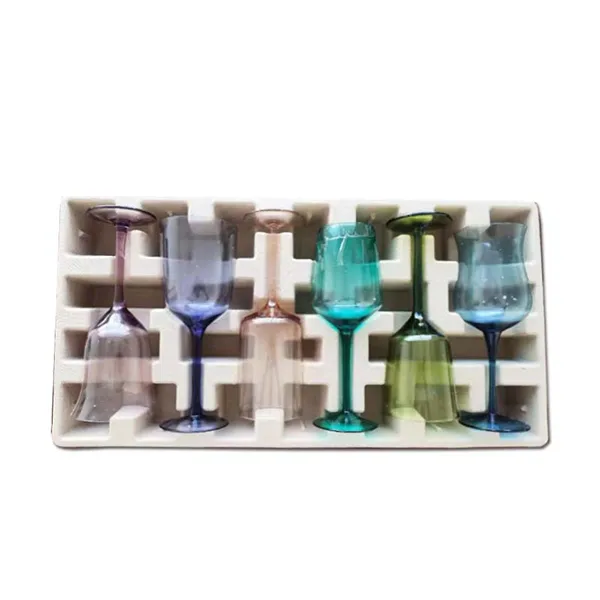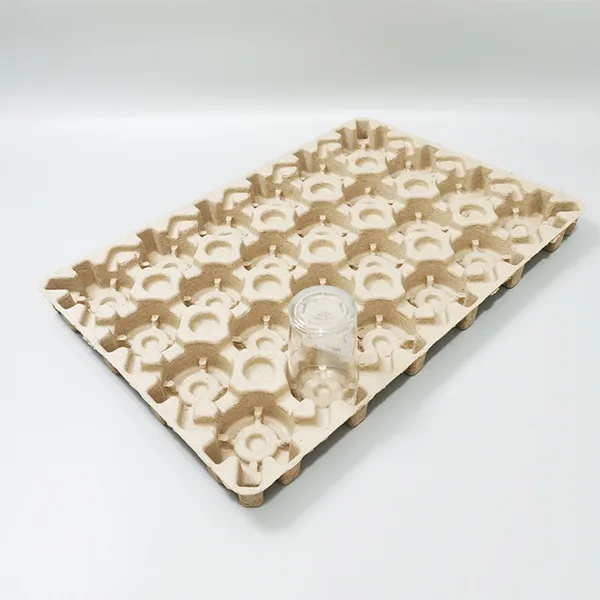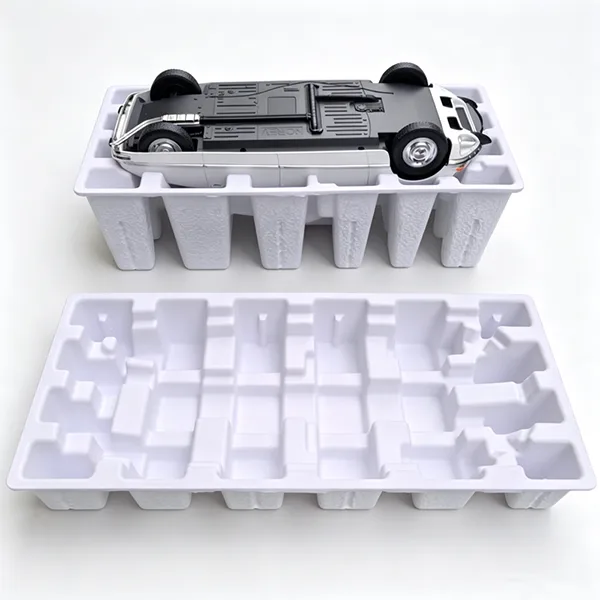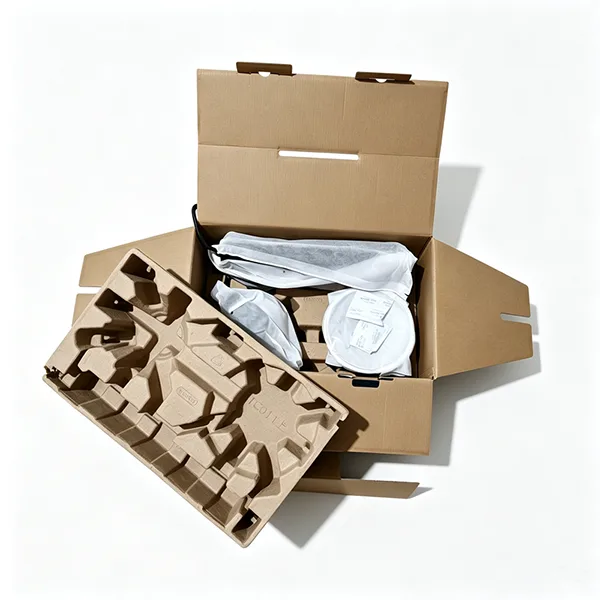
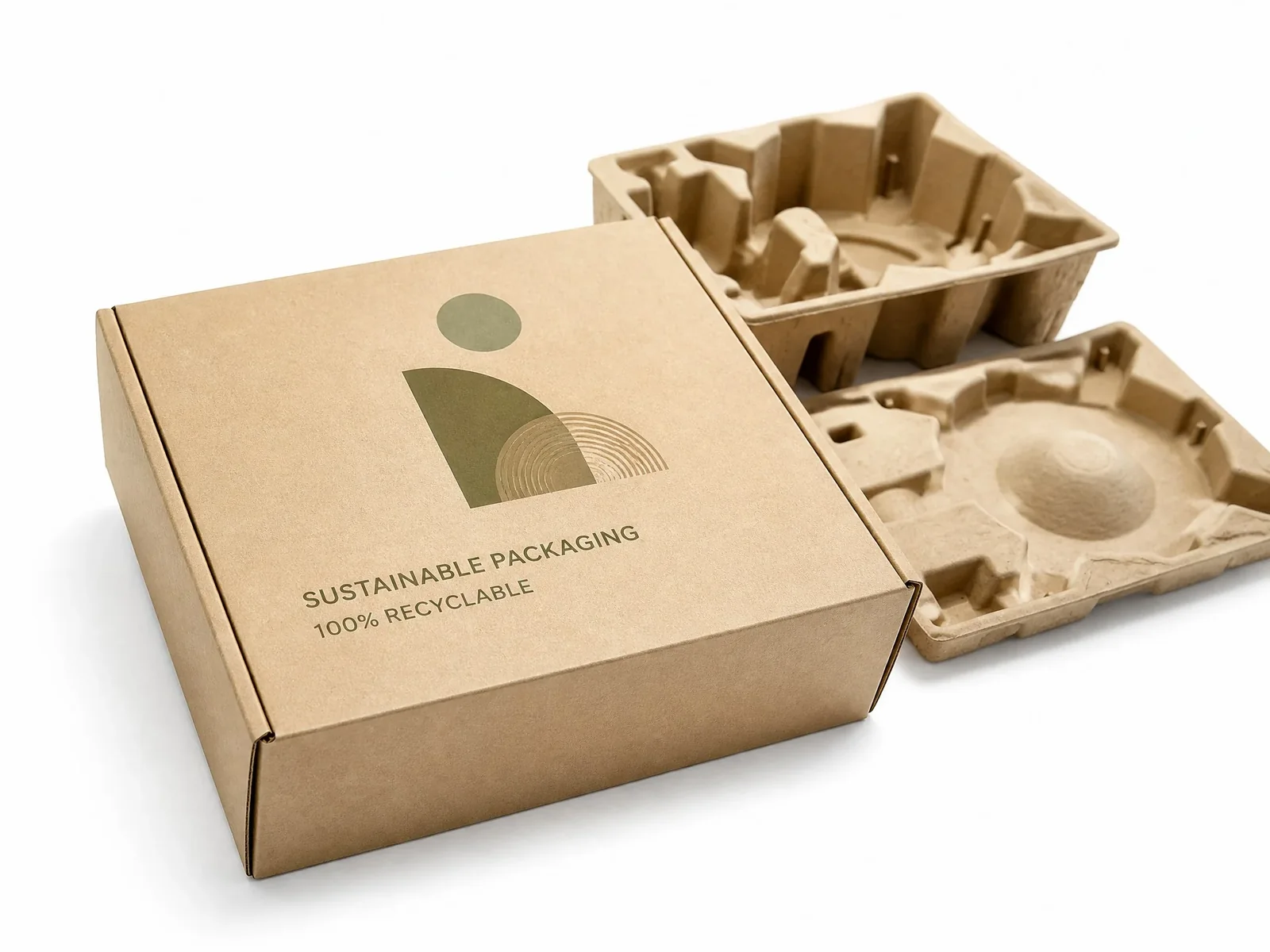
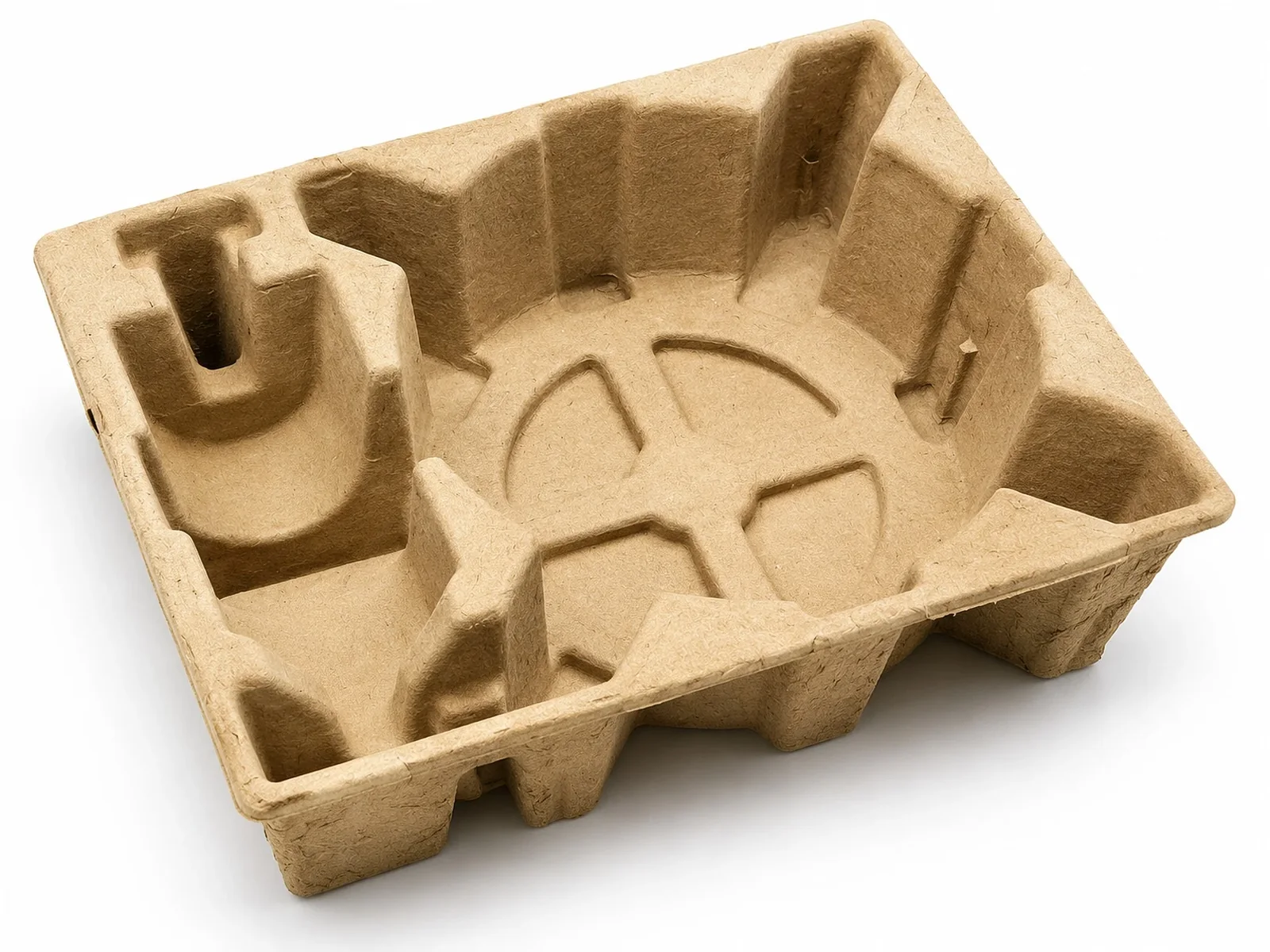
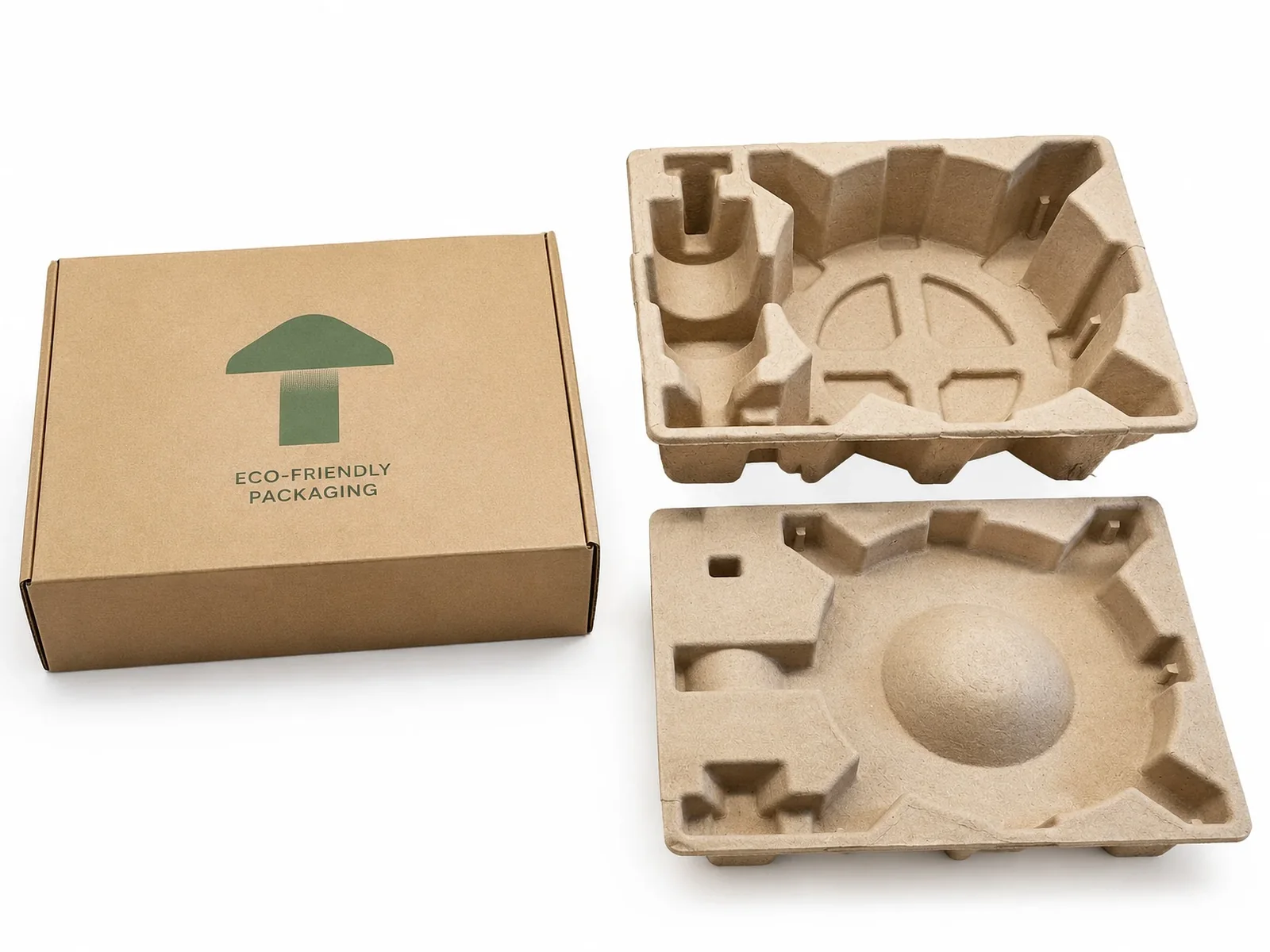
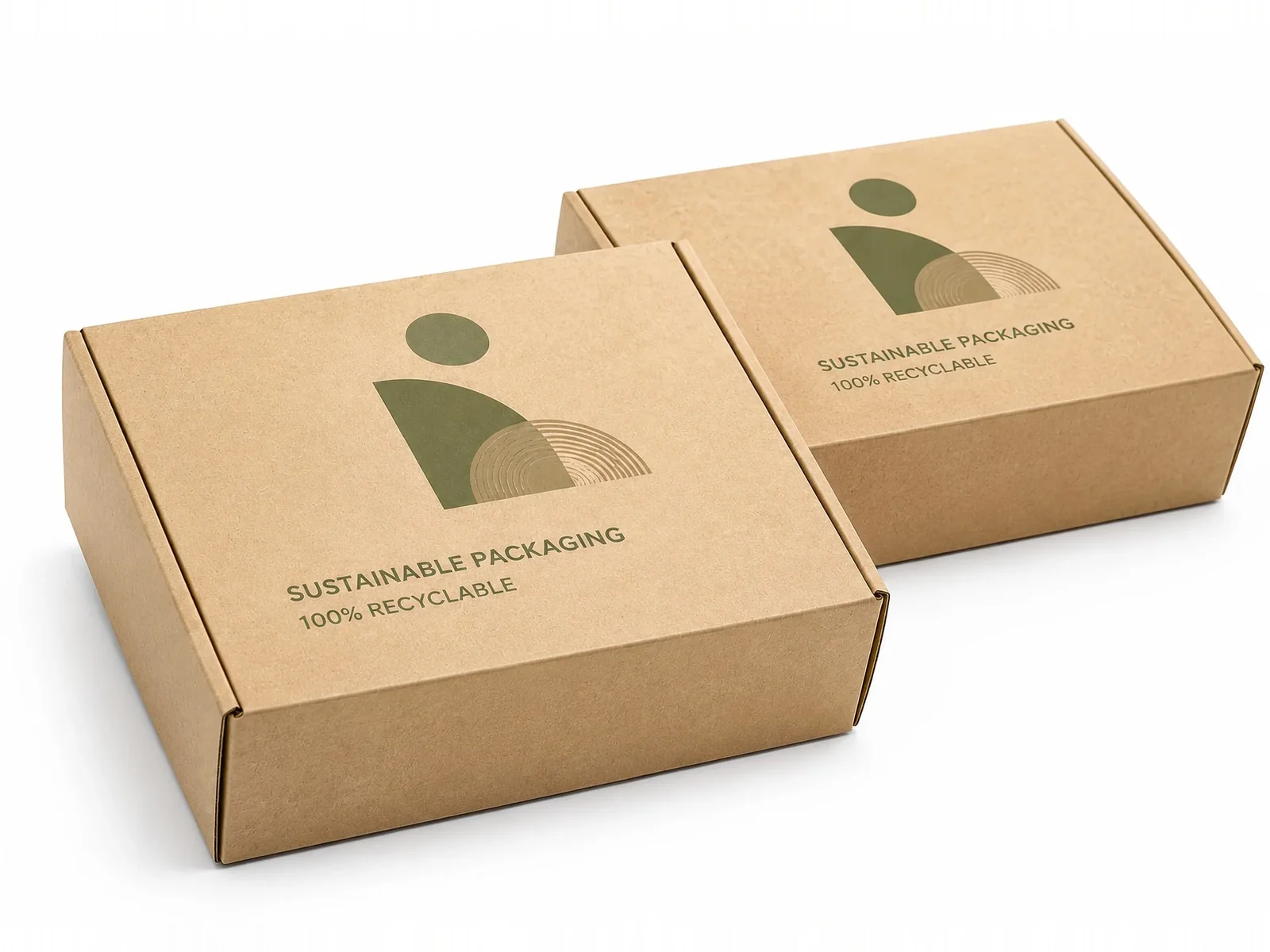
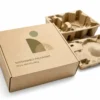
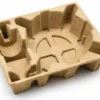
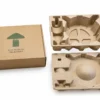
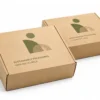
A ceiling light arrives as three objects that do not want to travel together: a shade that dents, a body that is heavier than it looks, and a driver with a cable hanging off it. This pack separates them in one carton. A dry-press yellow-pulp lower insert carries the body in a round cavity with a raised dome underneath and a slot down one side for the driver. A matching upper insert caps the shade so the rim cannot take the load of the carton above. The box is die-cut kraft corrugated, printed on the outside, and closes without tape.
Key Product Features
- Two inserts, not one. The lower tray locates, the upper cap restrains. A single tray leaves the shade free to rise on a drop.
- Dry-press yellow pulp, 1–3 mm. Unbleached, undyed fibre with a matte face; no coating, so it can go into the paper stream with the carton.
- Round cavity with an under-dome. The dome sits under the body so the heaviest point lands on fibre, not on the shade rim.
- Driver slot. An elongated pocket down one side keeps the driver and its cable away from the shade wall.
- Printed corrugated box. One-colour print on kraft, die-cut blank, tuck-lock base, no plastic tape required.
- Nothing plastic. No foam, no bubble bag, no PE bag, no plastic clip — the whole pack is one material family.
- Nests for freight. Trays stack inside each other before filling, so inbound freight is mostly air only at the carton stage.
Two Inserts, Two Jobs
| Part | Material | What it does |
|---|---|---|
| Lower insert | Yellow-pulp dry-press, 1–3 mm | Holds the luminaire body in a round cavity, spreads the load through an under-dome, and keeps the driver in a side slot |
| Upper insert | Yellow-pulp dry-press, 1–3 mm | Caps the shade, stops it rising on a drop, and forms the surface the carton lid closes onto |
| Outer carton | Kraft corrugated, die-cut | Carries the stack, takes the print and the handling marks, and provides the stacking strength the pulp does not |
The division matters at the drawing stage: the insert is drawn to the fixture, the carton is drawn to the insert plus a clearance. Change the fixture and only one drawing usually has to change — which is why the set is quoted as an integrated packaging solution rather than as a tray plus a box bought separately.
Luminaire Formats This Pack Fits
| Fixture type | Cavity design | Note |
|---|---|---|
| Ceiling and flush-mount lamps | Round cavity, under-dome, shade cap above | The format shown in the photographs |
| Pendant lights | Deeper cavity, cable routed in a channel | Cable pocket keeps the flex off the shade wall |
| Wall sconces and uplights | Asymmetric cavity with a bracket recess | Bracket pocket stops the arm pressing into the shade |
| Smart lamps with an external driver | Round cavity plus a separate driver slot | Driver stays connected but is not resting on the shade |
| Retail-ready sets | Same inserts, printed carton outer | Print carries the brand; the pulp stays unprinted |
Material & Eco Advantages
Yellow pulp is unbleached and undyed, so the tray is the colour of the fibre rather than a printed imitation of it. Both inserts and the carton go into the same paper recycling stream, and there is no laminating film, foam or plastic bag to separate at the end of life. For a luminaire, that also removes one step from incoming inspection: there is no foam block to cut and no bag to open before the fixture reaches the assembly bench.
Dry-press suits this pack because the insert locates and restrains rather than presents a printed face. Where a smooth, printable surface is needed, wet-press is the alternative — the trade-off is set out in our wet-press vs dry-press comparison, and the food-contact paperwork route in the molded pulp overview. For an electrical product, the relevant documents are a restricted-substance declaration and, where the retailer asks for it, transit test evidence on the assembled pack.
Product Specifications
| Item | Specification |
|---|---|
| Material | Yellow pulp (natural, undyed), dry-press molded fibre |
| Structure | Lower insert + upper insert + die-cut kraft corrugated carton |
| Wall thickness | 1–3 mm, set per drawing |
| Cavity tolerance | ±0.08–0.15 mm (dry-press); tighter on request |
| Carton | Kraft corrugated, die-cut blank, one-colour print, tuck-lock base |
| Printing on pulp | Deboss or blind emboss; no ink on the fibre by default |
| MOQ | 5,000 sets (dry-press); cartons quoted on the same order |
| Tooling | From US$2,400 per pulp tool; this set uses two pulp tools plus a carton die |
| Sampling | 10–15 working days after drawing approval |
| Production | 15–20 working days after sample sign-off |
| Terms | EXW / FOB / CIF / DDU |
Tooling and unit cost are broken down on the molded pulp cost, tooling and MOQ page; the shipping-tray range this pack belongs to sits under molded pulp trays for shipping.
Suitable Purchaser Groups
- Lighting brands shipping direct. The carton is the parcel, so the fixture does not need a second overbox.
- Retail and contract lighting suppliers. Printed kraft reads as specification-grade in a showroom and survives a pallet.
- Brands replacing EPS or EPE. Same cavity logic, one material family, no separation step at disposal.
- OEM and ODM factories. Two inserts plus a carton is a repeatable pack for a fixture family with shared shade diameters.
Frequently Asked Questions
Why two pulp inserts instead of one tray with a lid?
A hinged lid is drawn with the tray and shares its tolerance, so it restrains only what the tray already holds. Two separate inserts let the upper part be tuned independently — a domed cap over a shade is a different shape from a lid over a tray, and it can be swapped when the shade changes without retooling the base.
Can the pack carry a glass shade?
Yes, if the cavity follows the shade and the shade is not asked to carry load. The under-dome puts the mass on the body, and the upper cap restrains the rim without clamping it. For thin glass we would confirm with a drop test on the assembled pack before production, not assume it from the drawing.
Does the driver need its own pocket?
It should. A driver left loose in the cavity ends up against the shade wall, which is the part most likely to mark or crack in transit. The slot shown on the lower insert keeps the driver and its cable in one place and out of contact with the shade.
Is the pulp insert safe next to electrical parts?
The pulp itself is dry fibre with no coating, so there is no plasticiser or film in contact with the driver. Where a buyer’s compliance team needs it, we issue a restricted-substance declaration for the grade used, and the assembled pack can be drop tested to the buyer’s own protocol.
What is the minimum order?
5,000 sets for the dry-press inserts, with the corrugated cartons quoted on the same order so the two stay matched. Sampling runs 10–15 working days after the drawing is approved, and production 15–20 working days after sign-off.
Send a Fixture Drawing and We Will Draw the Cavity
Send the luminaire outline, the shade diameter at three heights, the driver dimensions with its cable exit, and the pack count per carton. We will come back with a cavity layout, a carton blank and a tooling quote for the two inserts and the die — and, if you are comparing options, with the same pack drawn as a bottle-style tray and pad set so you can see what the second insert buys you.