


Product Overview
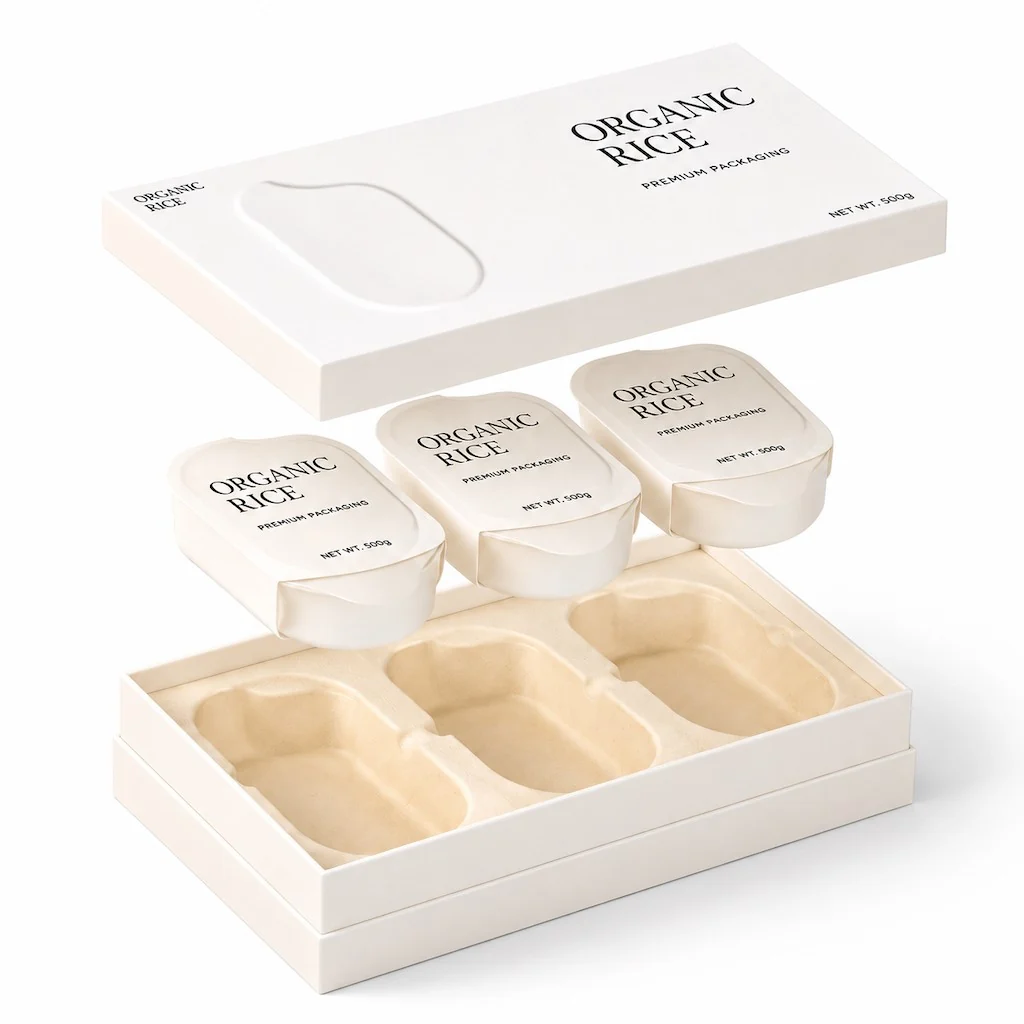
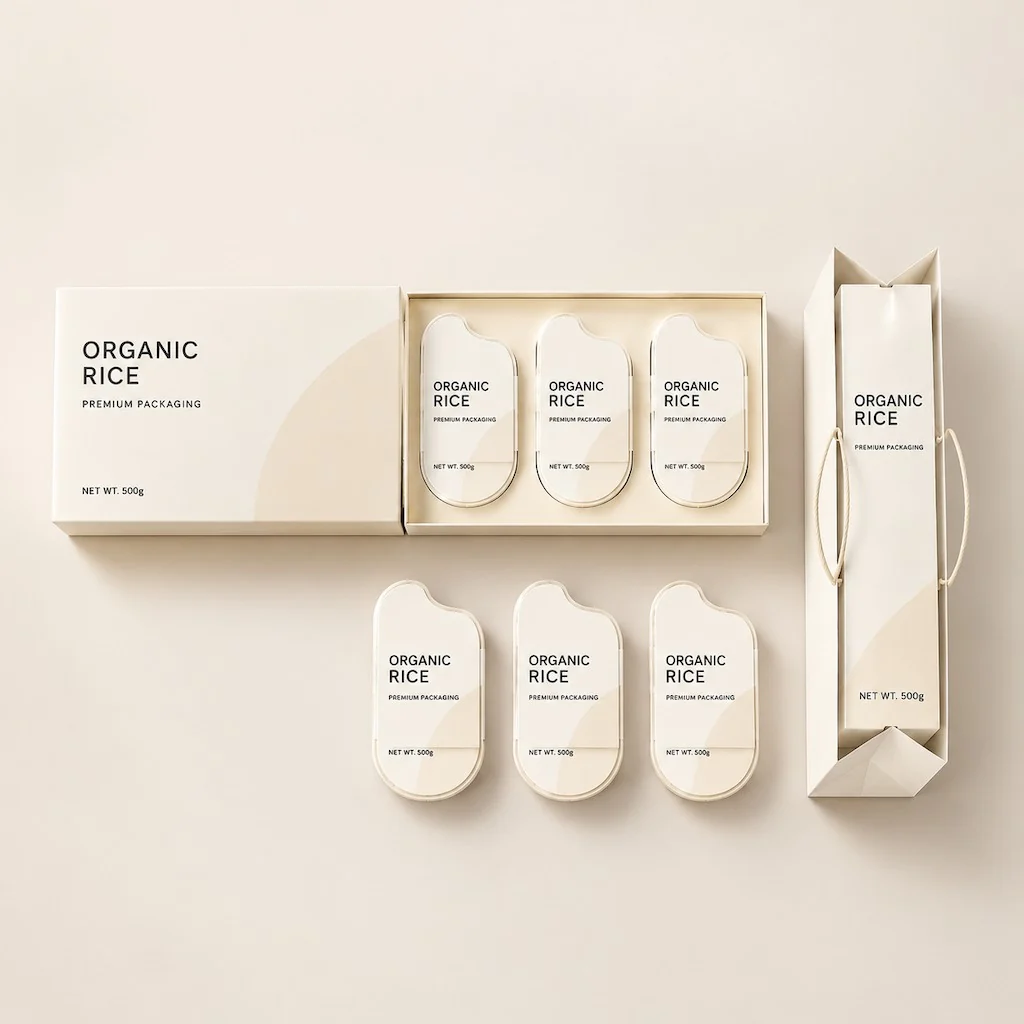
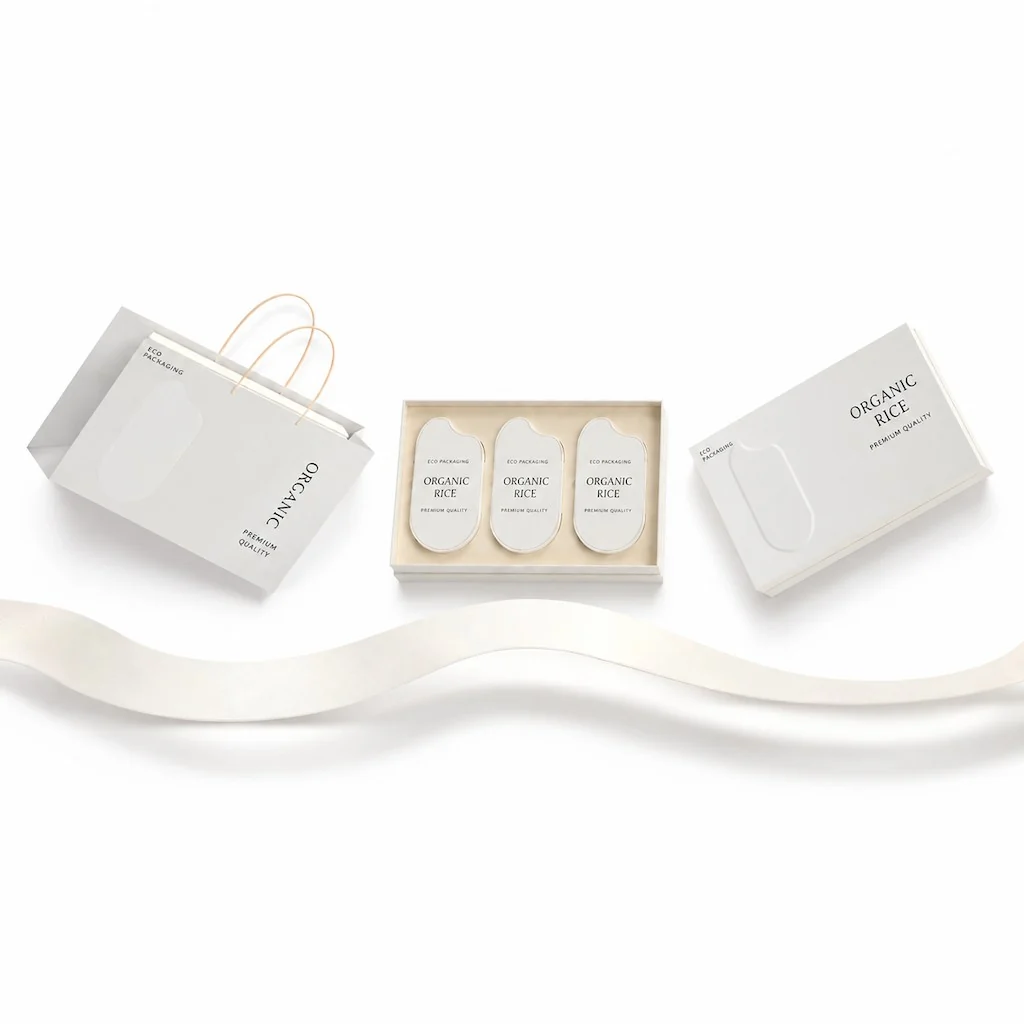
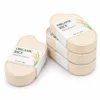
This is a rice pack built as one system rather than four purchases. A wet-press white pulp outer box closes over a formed pulp tray that carries three 500 g portion pods; each pod wears a printed paper belly band; the pods and tray drop into a rigid gift box for the multi-pack; and a paper carrier bag with rope handles takes the set out of the shop. Every component is paper. There is no plastic scoop window, no laminated liner and no foam pad inside the carton.
| Component | Material | Job it does |
|---|---|---|
| Outer box (lid + tray) | Wet-press white molded pulp, 0.8–1.5 mm | Locates three pods, carries the debossed emblem, holds the set closed without tape |
| Portion pods, 500 g | Wet-press white molded pulp | The unit the customer keeps, re-closes and scoops from |
| Belly bands | Printed paper band | Brand, variety, origin and net weight — changeable per SKU without a tool |
| Multi-pack gift box | Rigid greyboard with printed paper wrap | Shelf presence and gift presentation for the three-pod set |
| Carrier bag | Paper bag with twisted paper or rope handles | Retail carry-out that matches the pack instead of a printed plastic bag |
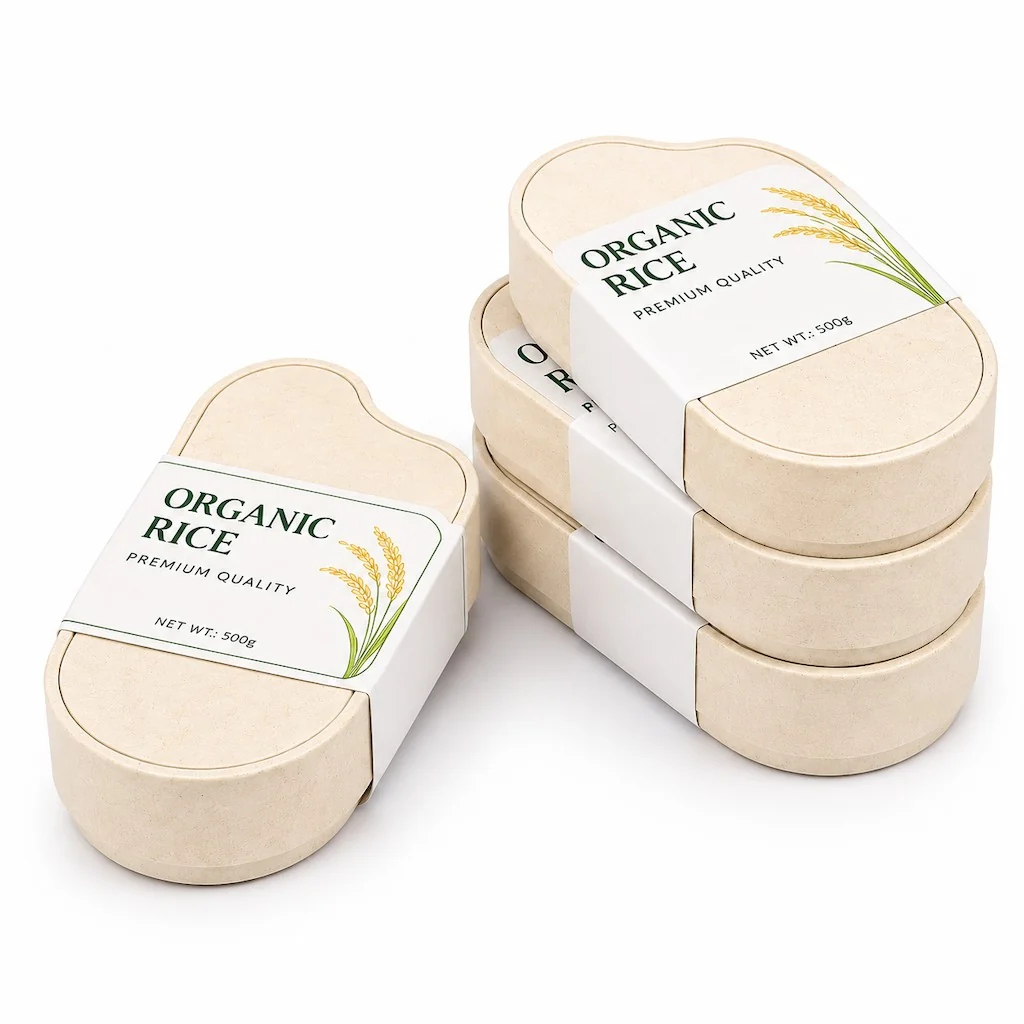
Wet-press is what makes the white version possible: 0.8–1.5 mm wall, ±0.03–0.05 mm cavity tolerance and a face smooth enough to print a net weight on. The photographs show the white set on the rigid box and, in the third image, the same pod cavity in a natural unbleached pulp with a white printed band — two finishes from one drawing.
Key Product Features
- White wet-press shell — a smooth, tight face that reads as premium paper on shelf, with cavity tolerance tight enough that three pods sit level in the tray.
- Deboss instead of print on the lid — the rice-grain emblem in the photographs is formed into the pulp, so it costs nothing per unit and cannot scuff off.
- Banded pods — the band carries SKU-level information, which keeps one tool serving several rice varieties.
- Rigid gift box for the multi-pack — the pulp set drops in as a unit, so the gift box needs no extra insert.
- Carrier bag in the same family — paper handles, paper body, and the same print language as the band.
- One material at the recycling point — pulp, band, box and bag all go into the paper stream; the only separation is the rigid box wrap if a recycler asks for it.
- Stackable and nestable — empty trays nest and pods stack, which keeps freight volume down before filling.
Rice Retailing Scenarios
| Product packed | Why this format fits |
|---|---|
| Premium organic rice, 500 g portions | Portioning protects aroma and lets the customer buy a fixed weight; the pod re-closes after opening. |
| Three-variety gift set | Three pods, three bands — one tool covers white, brown and black rice, which is what a gift set needs. |
| Farm-shop and deli counter retail | The outer box stands on shelf and the carrier bag closes the sale without a second packaging decision. |
| Corporate and festival gifting | Rigid box plus bag reads as a gift; the pulp inside is the story rather than a hidden cost. |
Material & Eco Advantages
Rice packaging usually fails on one point: the inner liner. A printed plastic window or a laminated bag is what keeps the paper claim from being true. Here the barrier is simply the pulp wall — dry rice does not need more — so the pod, the tray, the band, the rigid box and the bag all belong to the same stream. Dry rice is one of the simpler food cases; the constraints that shift across dry goods, liquids and alcohol are set out in our molded pulp packaging for food and beverage guide. The wet-press versus dry-press comparison explains where the white wet-press face is worth the tighter tolerance and where a natural dry-press part is the cheaper answer.
For compliance, what we can issue is a declaration rather than a certificate: FDA status for the paper components under 21 CFR 176.170 and 176.180, and a restricted-substance declaration in RoHS format for a defined grade. PPWR (EU 2025/40) applies to the packaging you place on the market — recyclability, recycled content over time, labelling — and is not something a converter holds. Our certifications and test standards guide lists what each document actually covers.
Product Specifications
| Material | Molded plant fibre, white wet-press (outer box, tray, pods); printed paper band; rigid greyboard gift box; paper carrier bag |
| Components | Outer box (lid + tray) + three 500 g pods + printed belly bands + multi-pack rigid gift box + carrier bag |
| Process | Wet-press, 0.8–1.5 mm wall, smooth white face |
| Cavity tolerance | ±0.03–0.05 mm; ±0.02 mm on a precision tool where the lid has to seat flush |
| Portion size | 500 g in the sample set; cavity drawn to fill volume and bulk density, so another weight is another tool |
| Branding | Deboss on the pulp; print on the band, the rigid box wrap and the bag |
| Food contact | FDA status declaration under 21 CFR 176.170 and 176.180 for the paper components; barrier liner specified only if the fill needs one |
| MOQ | 10,000 pcs wet-press; a natural dry-press version runs from 5,000 pcs. Rigid box and bag quoted on the same order |
| Tooling | From US$2,400 per pulp tool; this set uses a lid, a tray and a pod cavity, quoted per drawing. See the cost and tooling breakdown. |
| Testing | Drop test of the assembled gift set; compression on the rigid box at the stacking load you specify |
| Sampling | 10–15 working days |
| Production lead time | 15–20 working days after sample approval |
| Terms | EXW, FOB, CIF or DDU |
Suitable Purchaser Groups
- Rice mills and exporters moving to retail portions — a 500 g pod plus a printed band turns a bulk sack into a shelf SKU without a plastic film line.
- Organic and specialty rice brands — the white wet-press face and the debossed emblem carry a premium price without foil or varnish.
- Gift and hamper assemblers — three pods in one rigid box and a matching bag is a finished gift SKU, not a collection of parts.
- Brands consolidating packaging suppliers — pulp, band, rigid box and bag from one drawing set; the wine bottle shipper is the same approach applied to glass.
Frequently Asked Questions
Why four components instead of one pulp box?
Because retail and transit ask for different things. The 500 g pods are the unit the customer keeps and re-opens; the outer box and the rigid gift box protect and present them; the band carries the brand and the net weight; the carrier bag is what leaves the shop. Rolling them into one pulp shell would mean a single component doing four jobs badly.
Is the pulp food-contact safe for rice?
The pods are formed from virgin pulp and we issue an FDA status declaration for the paper components under 21 CFR 176.170 and 176.180, plus a restricted-substance declaration in RoHS format, for a defined grade. For dry rice no barrier coating is needed; if the portion is pre-cooked or oil-dressed, that is a different brief and the liner is specified on the drawing.
Does the 500 g pod work for other fill weights?
The cavity is drawn from the fill volume and the bulk density of your rice, so 500 g of a long grain and 500 g of a short grain are not the same cavity. The sample set in the photographs is built around a 500 g fill; a 250 g or 1 kg pod is a separate tool, not a resized copy.
Can the outer box be printed, or only the band?
Both. The band is the cheap place to put variable information — variety, net weight, harvest — because it is a printed paper part, not a tool. The outer box takes print or deboss: the sample uses a debossed rice-grain emblem on the lid, which costs nothing per unit once the tool is cut.
What are the MOQ and lead times?
10,000 pcs for the wet-press pulp parts, with a dry-press version from 5,000 pcs where a matte natural surface suits the brand. Tooling starts at US$2,400 per pulp tool and this set uses several, so it is quoted per drawing. Rigid box and bag are quoted on the same order. Sampling 10–15 working days, production 15–20 working days after approval.
CTA Closing Copy
Send the fill weight, the bulk density of the rice, whether the portion is raw or pre-cooked, the number of pods per gift box and the retail channel. We will come back with a pod cavity drawing, the tray and lid, band artwork dimensions and the rigid box spec as one set, so the pieces are known to fit before any tool is cut. Sampling takes 10–15 working days; production runs 15–20 working days after approval.
If the material is new to your team, start with what molded pulp packaging is; the Integrated Packaging Solution range covers the packs built the same way for other product types.