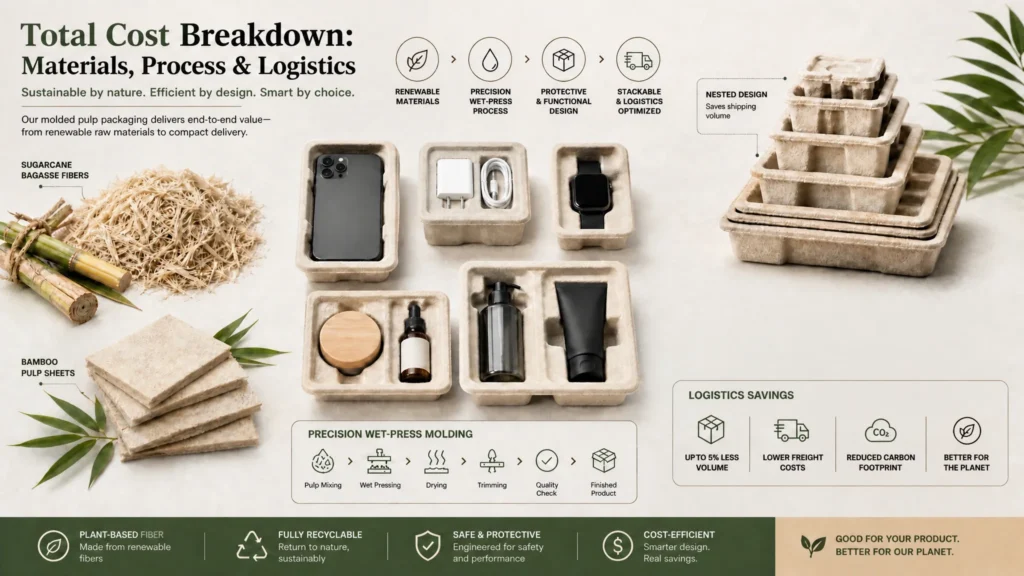
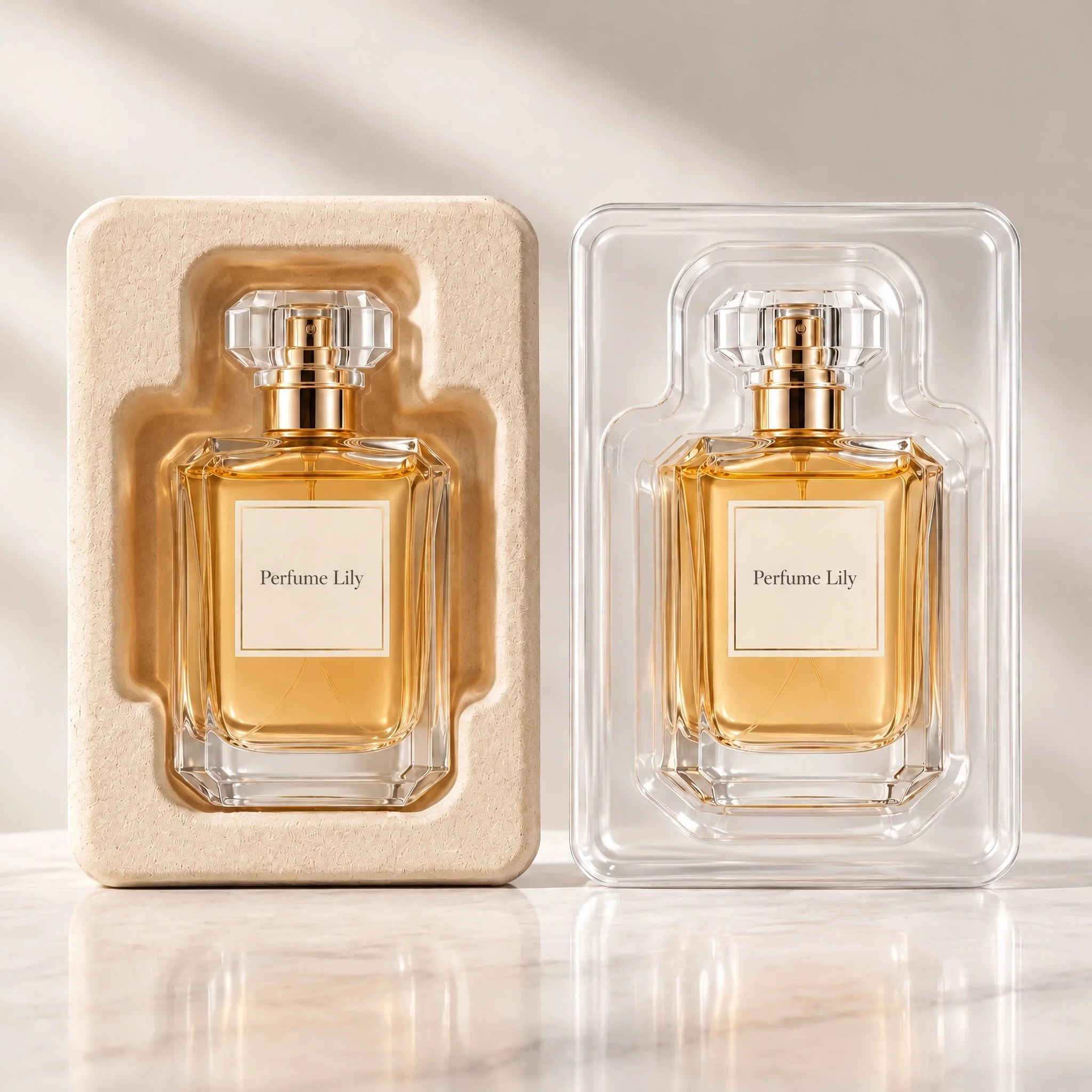
The short answer. Three criteria decide this, and they seldom point the same way. If the pack has to show the product, thermoforming wins — fibre cannot be transparent. If the part has to locate a bottle shoulder to a fraction of a millimetre, wet-press moulding can and dry-press cannot. If the route is humid, or the first order is small, both fibre processes carry a cost worth pricing before you commit.
For an opaque cosmetic packaging set of jars, tubes and a vial, ordered above ten thousand pieces and shipped dry, molded pulp is usually the lower-risk answer: it locates the components in one formed part, it nests, and it reaches the paper stream uncoated. The order of the questions matters — transparency first, precision second, volume last.
On this page
- Fibre against thermoformed plastic
- Where thermoforming wins
- Cavity tolerance is not part tolerance
- Four formats, four jobs
- Export: humidity, transit, documents
- MOQ economics and tooling
- Comparing cost without being misled
- Compliance files retailers ask for
- Six questions before you order
- Frequently asked questions
- Send a drawing
Material comparison: molded pulp against thermoformed plastic
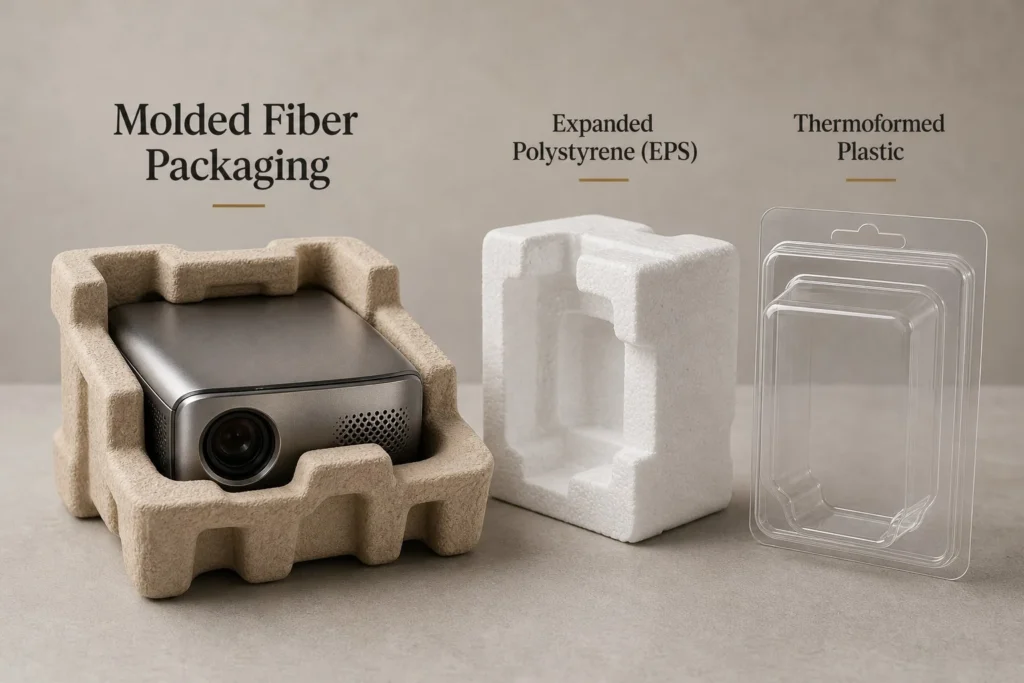
Molded pulp is formed from a water-based fibre slurry onto a shaped tool and dried, so the wall is built by the fibre itself: the material has thickness before it has strength. Thermoformed plastic starts as a flat sheet, heated, drawn over a tool and trimmed, so the sheet sets the wall and the tool sets only the outline.
In cosmetic packaging that difference surfaces in five places: wall thickness, the precision with which a cavity holds a bottle, the surface under shop lighting, behaviour in wet air, and the waste stream the part enters. Read the table as trade-offs, not a scoreboard.
| Criterion | Molded pulp, wet-press | Molded pulp, dry-press | Thermoformed plastic |
|---|---|---|---|
| Wall thickness | 0.8–1.5 mm, formed by the fibre | 1–3 mm, thicker and softer | Set by the sheet gauge; thin walls are the point |
| Cavity tolerance | ±0.03–0.05 mm; ±0.02 mm on a precision cavity | ±0.08–0.15 mm | Holds location more tightly than dry-press fibre |
| Surface | Smooth on the tool side, one face | Textured, softer edge | Gloss or matte, transparent if the sheet is |
| Moisture | Hygroscopic: softens and moves | Same behaviour, more mass | Does not absorb water the way fibre does |
| End of life | Paper stream | Paper stream | Plastic stream, where collection exists |
| Tooling | From US$2,400, quoted from the drawing | From US$2,400, quoted from the drawing | Quoted by the converter; not published here |
| Minimum order | 10,000 pcs | 5,000 pcs | Set by the converter, not by us |
Across plastic, foam and corrugated, the material comparison runs the same criteria over the other substrates.
Where thermoforming wins
Three cases, stated plainly.
The product has to be seen. No fibre format is transparent. Where the pack is the display — a bottle that sells because the liquid is visible — thermoforming answers a question fibre cannot attempt, and a die-cut window in a cosmetic packaging tray is a compromise rather than a substitute.
The route is wet. Chilled logistics, condensation on a container roof, high ambient humidity: a closed sheet ignores all three. Fibre absorbs, softens and loses compression strength, and a coated grade that resists moisture compromises the recyclability claim that motivated the switch.
The wall must be thin. Where shelf density demands a slim pack, or a component must sit inside a very tight envelope, thermoforming gives the designer more room. Molded pulp holds the tighter cavity of the two when wet-pressed, but it cannot match a thin drawn sheet in the same space.
Cavity tolerance is not part tolerance
The number on a quotation usually describes the tool, not the tray. That distinction causes more failed cosmetic packaging projects than any other error: a cavity held to ±0.03–0.05 mm does not guarantee a molded pulp part where every critical dimension sits in that band. Between the two lie draw depth, wall-thickness variation, shrinkage during drying, and the moisture the part regains before it reaches the filling line.
By process, the figures we quote are wet-press cavities at ±0.03–0.05 mm, precision cavities at ±0.02 mm, and dry-press at ±0.08–0.15 mm. Those are the numbers to compare against a bottle drawing. Where a glass shoulder must be held without movement, specify wet-press; where the product only needs separation inside a carton, dry-press molded pulp is cheaper and the wider band is irrelevant.
On top of the cavity figure, a deep draw moves more fibre and is harder to hold than a shallow pocket, and a thin wall dries faster than a thick one — which matters on a cosmetic packaging tray with tall pockets.
So ask for three things. A drawing that tolerances the dimensions that matter, not a blanket note. A first-article report on those dimensions, not on the outline. And samples measured after conditioning — a tray that fits on the day it is packed has not been proven in a humid warehouse.
Four formats, four jobs
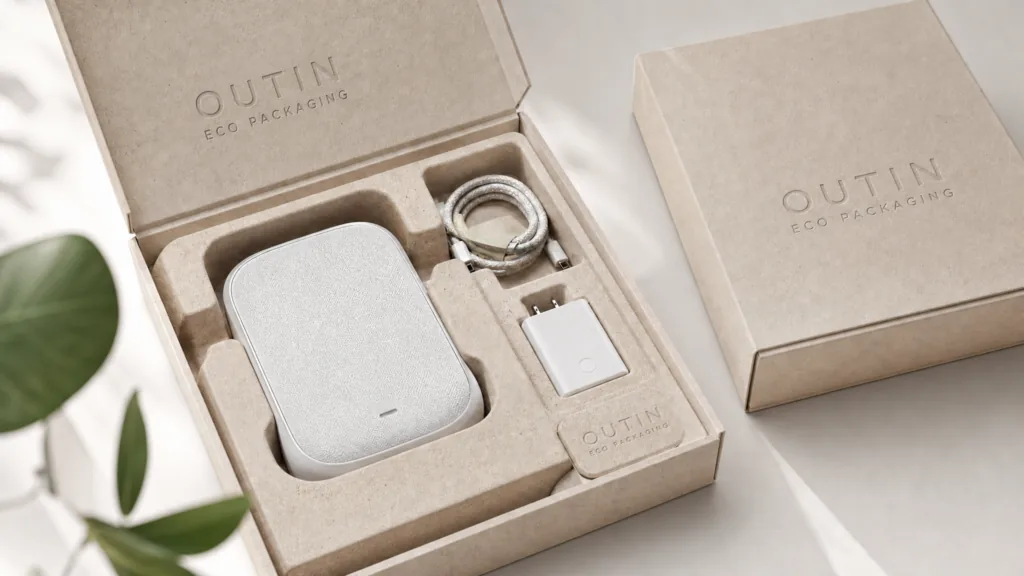
The molded pulp tray range for skincare and cosmetics covers four cosmetic packaging structures that are not interchangeable — each answers a different retail problem, which makes the choice a merchandising decision before it is a cosmetic packaging one.
One bottle, sold alone. A single-tube tray with a paper band suits a serum travelling as a single unit, where the carton is opened once and the tray is the last surface the buyer touches.
A routine in one box. A five-cavity set tray carries a jar, tubes and a vial in one formed part and adds a die-cut handle, so the pack is also the carry structure and the shelf display.
The bottle has to be visible. A windowed perfume pack opens a die-cut aperture instead of fitting a plastic window, keeping the fibre surface while the glass shows.
Shelf space without a shelf. A hanging shampoo pack pairs a formed cradle with a punched header and a cord handle, because a peg is often the only space a retailer gives a new cosmetic packaging line. Where the set has to sit inside a rigid box instead of a tray, a three-cavity folding insert card does the same locating job.
Export: humidity, transit, documents
Molded pulp cosmetic packaging projects rarely fail at the tool. They fail in a container, after the drawings were approved and the first shipment looked perfect. A container crossing climate zones condenses moisture on the inside of the roof, it drips onto the top cartons, fibre wicks it, and a tray that held a bottle in the sample room no longer does.
The countermeasures are cheap against a rejected shipment: desiccant in each carton rather than one sachet per pallet, a poly liner on the outer layer, and cosmetic packaging parts packed at a controlled moisture content.
Test to a published protocol, not an internal one: ISTA 3A for parcel delivery, ASTM D5276 for free-fall drop. Condition the samples first — a dry part that passes says nothing about a part that spent a month at sea — and inspect the molded pulp tray too, because a cracked insert that protected the bottle is still a failed design.
On documents, a cosmetic packaging shipment needs little beyond a commercial invoice, a packing list and a bill of lading. What importers add is a food-contact declaration of compliance, a restricted-substance declaration and, increasingly, an EPR registration reference for the market where the pack is placed. Ask before the order ships.
MOQ economics and tooling
Our minimums follow the process, not the product: 10,000 pcs wet-press, 5,000 pcs dry-press. A stock mould would allow 1,000 pcs, but that covers only shapes already held as general moulds — the four cosmetic packaging formats above are custom, so the stock-mould minimum does not apply.
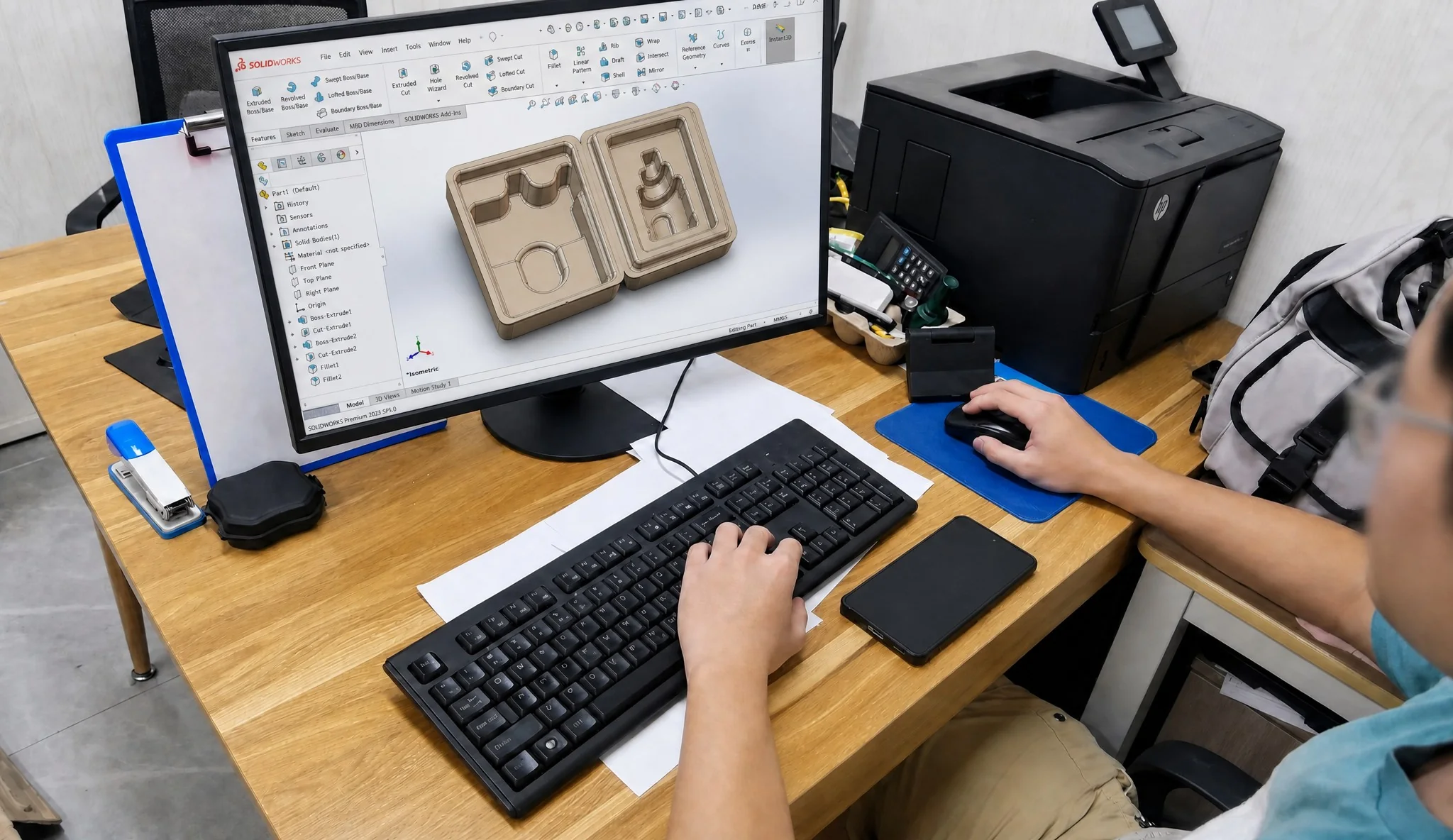
Tooling is from US$2,400, quoted from the drawing rather than a table, paid with the first order and not charged again on repeats. That is what makes the arithmetic work for a molded pulp tool: it serves every colour, print and artwork variant of the same geometry, so the per-unit burden falls at each reorder.
Sampling runs 10–15 working days, production 15–20 working days after the sample is approved. Terms are EXW, FOB, CIF or DDU, so normalise any cosmetic packaging comparison to one of them before treating a price as comparable.
Comparing cost without being misled
Four lines decide the answer and only one appears on a molded pulp quotation: material, tooling amortised across the order, conversion, and freight including cartons per pallet. A cosmetic packaging quote covering the first three and ignoring the fourth is not wrong, it is incomplete, and that is where most cost comparisons break.
| Error | What it hides |
|---|---|
| Comparing ex-works against delivered | Freight can exceed the gap between two suppliers. Normalise to one Incoterm first. |
| Amortising tooling in one quote only | A molded pulp part looks expensive at a small quantity and cheap at a large one. Tooling is paid once; the unit price is not. |
| Ignoring cartons per pallet | Nestable trays change freight and warehousing cost, and neither line reaches the packaging invoice. |
| Treating the first sample as the specification | A good sample without a written spec is one good day. The second order is where the difference shows. |
For the four lines themselves and what a quotation should contain, see the cost and tooling breakdown.
Compliance files retailers ask for
Food contact is the first question, and the answer is a declaration rather than a certificate. For paper and board components the evidence is a statement of compliance against FDA 21 CFR 176.170 and 176.180, issued for the specific furnish and any coating. A supplier answering “FDA certified” is describing something that does not exist; what exists is a declaration for a defined grade, which is why cosmetic packaging buyers ask for the grade, not the logo.
Restricted substances come second. Buyers often request a declaration in a RoHS format even though RoHS addresses electrical and electronic equipment — the format has become shorthand for “tell me what is in this material”, answered per cosmetic packaging grade rather than per factory.
PPWR is third, and most often mislabelled. The Packaging and Packaging Waste Regulation (EU 2025/40) is a regulation, not a certification: nobody holds PPWR, and a supplier claiming to be “PPWR certified” is either confused or selling you something. It creates obligations on the cosmetic packaging you place on the market — recyclability, recycled content over time, labelling — so ask whether this part and its marking meet the requirement in your market.
Compostability, if a cosmetic packaging buyer raises it, is a property of a grade evidenced against a standard for that grade, not a property of the converter. We claim no scheme we have not been assessed against.
Six questions before you order
- Must the buyer see the product through the pack? If yes the material question is closed and the work moves to structure.
- Must the component be located, or merely separated? Location calls for wet-press or thermoforming; separation is served by dry-press or a die-cut fitment.
- Which dimensions matter, and are they toleranced? An untoleranced drawing has no acceptance criterion and no first-article basis.
- How does the carton travel? Sea, parcel and air load a cosmetic packaging set differently, and only one of them drips.
- What is the annual volume, not the first order? A molded pulp tool from US$2,400 and a 10,000 pc minimum only pay back across repeats.
- Which documents will the importer want? Food contact, restricted substances and EPR references take longer to obtain than the trays do.
If a tool order is the next step rather than the tray, what buyers check before a tool order lists the evidence worth requesting before money moves.
Frequently asked questions
Is molded pulp suitable for cosmetic packaging?
For opaque packs, yes. It holds jars, tubes and vials in one formed part, nests for freight and reaches the paper stream uncoated. It is the wrong choice where the pack must be transparent, where the route is wet, or where volume is too low for tooling plus a 10,000 pc minimum.
Can a molded pulp tray hold a glass bottle tightly enough for parcel shipping?
With a wet-press cavity, usually yes. A formed shoulder holds the bottle at the base and under the cap, and cavity tolerances of ±0.03–0.05 mm, or ±0.02 mm on a precision cavity, remove the movement that causes breakage. Confirm it with a drop test under ISTA 3A.
How does humidity affect molded pulp cosmetic packaging in sea freight?
Fibre is hygroscopic: it absorbs moisture, softens and moves dimensionally, and condensation on a container roof is enough to soften the top cartons. Desiccant per carton, a liner on the outer layer and packing at a controlled moisture content are the usual controls; a coated grade changes the recyclability position.
What is the minimum order quantity for molded pulp cosmetic packaging?
10,000 pcs wet-press and 5,000 pcs dry-press. A 1,000 pc minimum exists only for shapes held as stock moulds, and the cosmetic packaging formats we produce are custom, so that route does not apply.
Is PPWR a certification?
No. PPWR is the Packaging and Packaging Waste Regulation, EU 2025/40 — a legal obligation on packaging placed on the EU market, not a certificate a supplier can hold. What can be evidenced is the compliance of a specific part and its marking.
Is molded pulp food-contact certified?
No such certificate exists for the material. Compliance is evidenced by a declaration covering a defined grade — for paper and board, typically a statement against FDA 21 CFR 176.170 and 176.180. The declaration follows the furnish and any coating, so it is issued per grade, not per factory.
Send a drawing
Send a component drawing, the annual volume and the route the carton takes, and we will say which process we would specify — including where a wet-press molded pulp part would cost you something you may not want to spend. Start from the molded pulp tray range for skincare and cosmetics, or read what molded pulp packaging is if the material is new to your cosmetic packaging team.