The definition in two sentences
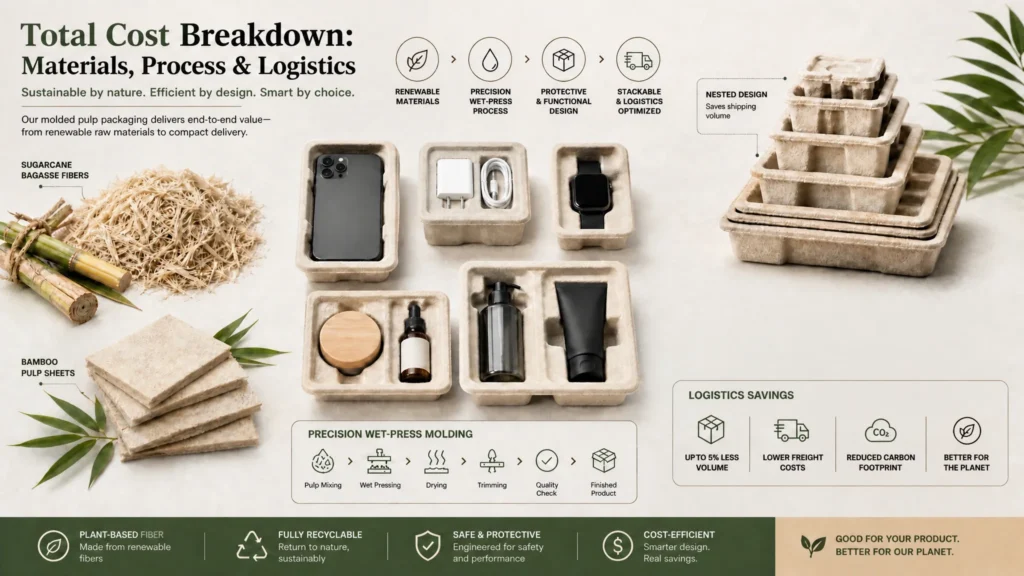
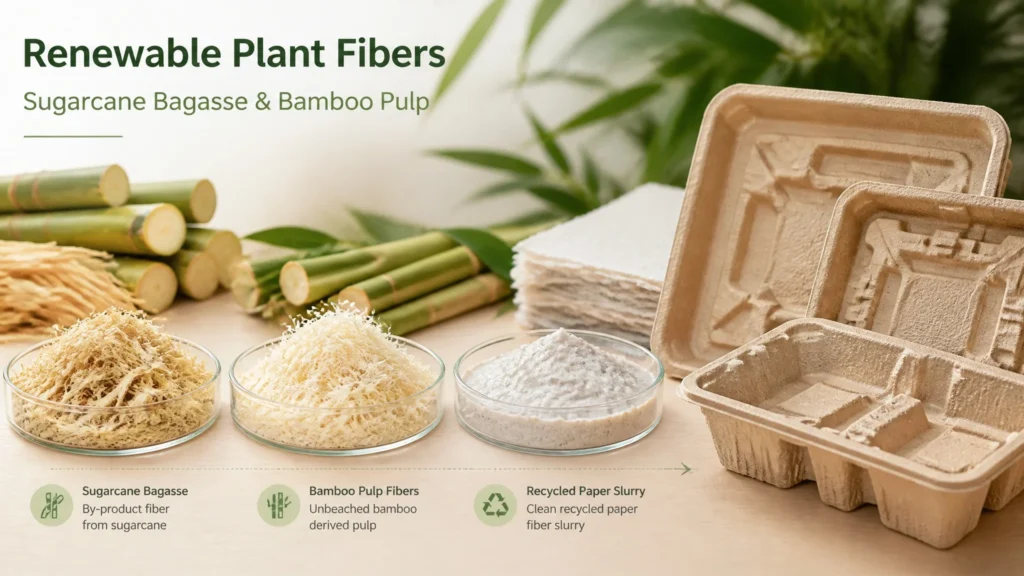
Molded pulp packaging is a protective packaging format made by forming a water-based slurry of plant fibre onto a shaped mesh tool, then dewatering and drying it into a rigid three-dimensional part. The fibre comes from recycled paper, sugarcane bagasse, bamboo or wood pulp, and the finished part replaces plastic blisters, foam inserts and vacuum-formed trays in the same box.
What this guide covers
- What molded pulp packaging actually is
- What it is made from
- The four processes, and why they behave differently
- How a part is designed
- The formats you can buy
- What it does well, and where it fails
- Sustainability, without the greenwash
- Cost structure and MOQ
- Certifications and declarations
- How to specify it: a 12-point RFQ checklist
- Five mistakes that cost buyers money
- Frequently asked questions
What molded pulp packaging actually is
Molded pulp packaging — also written moulded pulp packaging, moulded fibre or molded fiber packaging — is not a material that gets cut and folded. It is a shaping process. Fibre is suspended in water, drawn onto a tool whose surface is the negative of your part, and then dried until the fibre locks into a rigid shell. That single fact explains nearly everything else about the format: why it can hold a bottle in a cavity with no folding, why the same part can come out smooth on one line and rough on another, and why two suppliers can quote the same drawing at prices that differ by a factor of three.
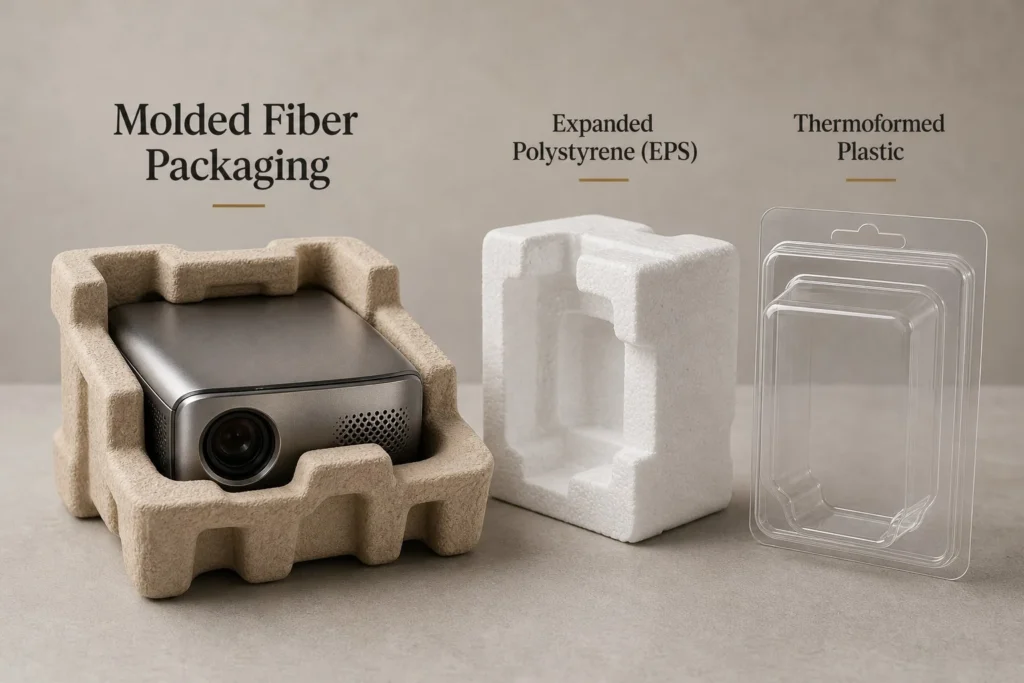
Molded pulp packaging sits between two things buyers already know. It is not corrugated board, which is a flat sheet converted by cutting and folding. It is not thermoformed plastic, which is a sheet heated and sucked over a mould. Molded pulp starts as a liquid and ends as a solid, and the tool is the product definition. The consequence for procurement is direct: the tooling decision is the product decision, and it is usually paid once, on the first order. A full material comparison against plastic, foam and corrugated is on our packaging material comparison page.
Where the format came from, and why that still matters
The molded pulp packaging process was industrialised in the early twentieth century for egg trays, and the egg tray is still the clearest demonstration of what the format is good at: a part with thin ribs, deep draws, no assembly, produced in high volume at a cost per unit measured in cents. Molded pulp packaging for consumer electronics, cosmetics and appliances arrived later, when buyers needed a plastic-free alternative that could still be dropped from a height and survive.
That history left the industry with two production cultures — one built for volume and cost, one built for appearance and tolerance — and most sourcing confusion comes from mixing them. A supplier whose line is tuned for egg trays will quote a cosmetic insert cheaply and then deliver something with visible fibre clumps and a wavy edge. A supplier tuned for retail inserts will quote accurately and then decline a 3,000-piece run that does not cover the setup.
Molded pulp packaging versus the alternatives
Buyers rarely choose molded pulp in isolation. The realistic comparison is against expanded polystyrene, EPE foam, thermoformed PET and folded corrugated. The table below states the trade honestly, including the cases where the alternative wins.
| Criterion | Molded pulp | EPS / EPE foam | Thermoformed PET |
|---|---|---|---|
| Tooling cost | From US$2,400, paid once | Low for simple blocks | Moderate to high |
| MOQ | 1,000 pcs wet-press / 5,000 pcs dry-press | Often volume-driven, can be low | Usually high |
| Surface finish | Smooth one side on wet-press; textured otherwise | Uniform, matte or gloss | Transparent, high gloss |
| Dimensional precision | Tight on wet-press, loose on dry-press | Loose | Tight |
| End-of-life | Recyclable in the paper stream; compostable grades exist | Rarely recycled in practice | Recyclable where PET streams exist |
| Where the alternative wins | — | Very low MOQ, extreme cushioning, waterproof need | Retail visibility, humidity, repeated reuse |
What molded pulp packaging is made from
Four fibre families cover most molded pulp packaging production. The choice affects colour, strength, surface and — often decisively — whether the part can carry a food-contact or recycled-content claim.
| Fibre | Source | Natural colour | Typical use |
|---|---|---|---|
| Sugarcane bagasse | Residue after juice extraction | Light cream to pale tan | Food service, retail inserts, cosmetics |
| Bamboo pulp | Fast-growing grass fibre | Pale, slightly green cast | Thin-wall parts needing stiffness |
| Recycled paper / OCC | Post-consumer cartons and board | Grey to brown | Industrial cushioning, egg trays, end caps |
| Wood pulp (virgin) | Managed forestry | Near white | Bright retail inserts, premium unboxing |
Two properties of the fibre matter more than the marketing name on a molded pulp packaging datasheet. The first is fibre length: longer fibres entangle into a stronger sheet, which is why a part made from virgin wood pulp can be thinner and stiffer than the same part made from heavily recycled stock. The second is consistency: recycled furnish varies batch to batch, and that variation shows up as colour drift between shipments — the single most common complaint on industrial-grade molded pulp, and the reason buyers of retail-facing parts often specify a virgin or controlled-blend grade instead.
Colour is a specification, not a promise
Unbleached fibre gives a natural tone that shifts with furnish and drying. If a brand requires a specific off-white across a season, that has to be written into the purchase order as a colour target with an agreed tolerance, and it usually means fixing the furnish rather than letting the mill substitute. Where colour matching is critical, the honest answer is that molded pulp is a weaker choice than a printed carton, and the part should be designed so its natural tone reads as intentional.
The four processes, and why they behave differently
Almost every sourcing argument about molded pulp packaging is really an argument about which of four process families is being quoted. They share a raw material and nothing else: wall thickness, surface, tolerance, tooling and minimum order all change.
| Process | Wall thickness | Surface | Tolerance | Best for |
|---|---|---|---|---|
| Wet-press (precision) | 0.8–1.5 mm | Smooth both faces, one side tool-finished | Cavity ±0.03–0.05 mm; precision cavity ±0.02 mm, ±0.015 mm at the limit | Retail inserts, cosmetics, electronics |
| Dry-press | 1–3 mm | Textured, visible fibre | Cavity ±0.08–0.15 mm; precision cavity rarely inside ±0.05 mm | Industrial cushioning, heavy parts, shippers |
| Thick-wall | Substantially thicker; formed then oven-dried | Rough, open fibre | Loose — treated as cushioning, not as a locating feature | Impact protection, corner blocks, egg trays |
| Thermoformed (transfer moulded) | Thin, drawn wet then pressed in a heated tool | Smooth, sharp detail | Tighter than dry-press; not equal to wet-press | High-detail shapes, deep draws |
For molded pulp packaging, Outin quotes the first two — wet-press and dry-press — because they cover the two intents that actually appear in a B2B enquiry: a part that must look right on a retail shelf, and a part that must survive a pallet drop. If your drawing needs thick-wall cushioning, that is a different supply chain and it is better to say so at the enquiry stage than to discover it after tooling.
Why the tolerance number in a quotation is usually about the tool
When a supplier states ±0.02 mm on a molded pulp part, that figure describes the mould cavity as machined, not the fibre part that comes out of it. The part itself carries additional variation from pulp consistency, moisture at demoulding and shrinkage during drying, and that variation is an order of magnitude larger than the tool tolerance. Confusing the two is the most expensive misreading in this category: a buyer specifies ±0.02 mm believing it is a part tolerance, the first article measures several tenths of a millimetre out, and the relationship starts with a dispute.
The workable approach in molded pulp packaging is to specify three things separately — the feature that must locate the product, the clearance around it, and the cosmetic zone — and to accept that only the first deserves a tight number. Everything else should carry a generous one, because a generous tolerance is cheaper to hold and cheaper to inspect.
How a molded pulp part is designed
Design rules for molded pulp packaging come from the physics of draining water through fibre, and they are less forgiving than injection moulding in some directions and more forgiving in others.
Draft and draw
Every vertical face needs draft, because the wet part is soft when it leaves the tool and tears if it is dragged. Deep draws are possible, but they thin the wall at the base and are the first place a tool will fail. A cavity that is 60 mm deep with a 1 mm wall is a different engineering problem from one that is 15 mm deep, and it should be quoted as such.
Radii and ribs
In molded pulp packaging, sharp internal corners do not fill. Fibre bridges across them and leaves a void or a thin spot, so internal radii are generous by default. Ribs are the main structural device — a rib adds stiffness with almost no material — but a rib that is too narrow will not fill either, and a rib that is too deep will crack at the root during demoulding. Ribs are also the feature that makes a 1 mm part behave like a 3 mm part, which is why they appear in every serious lightweighting design.
Shrinkage and the tolerance stack
Fibre parts shrink as they dry, and the shrink is not uniform: it is larger across the draw than along it, and it varies with wall thickness. The practical consequence is that a long dimension cannot be held as tightly as a short one, and a dimension measured across two separate cavities will drift more than a dimension inside one cavity. Good drawings acknowledge this by dimensioning from a single datum rather than chaining dimensions across the part.
Where the product touches
The contact geometry in molded pulp packaging deserves more attention than it usually gets. A product resting on a flat fibre face will mark if the fibre is rough, and will rattle if the cavity is loose. The usual solutions are a defined seating ring, local embossing to create a small contact pad, or a two-material approach where a thin film or paper wrap sits between product and fibre. Each adds cost and each should appear on the drawing, not in a conversation after the first sample.
The formats you can buy
Molded pulp packaging is sold in a small number of recognizable formats. Most projects are a variation on one of them.
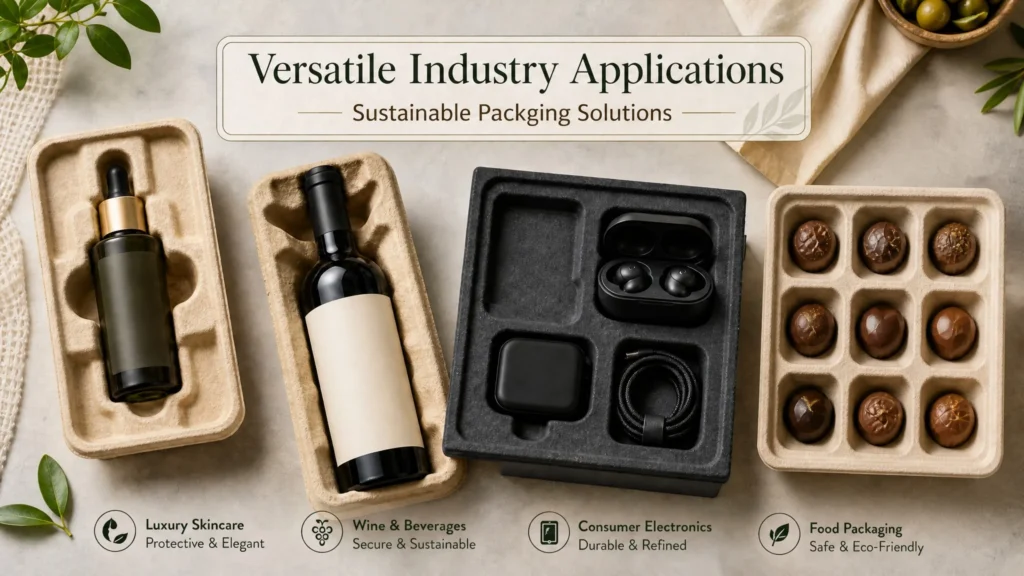
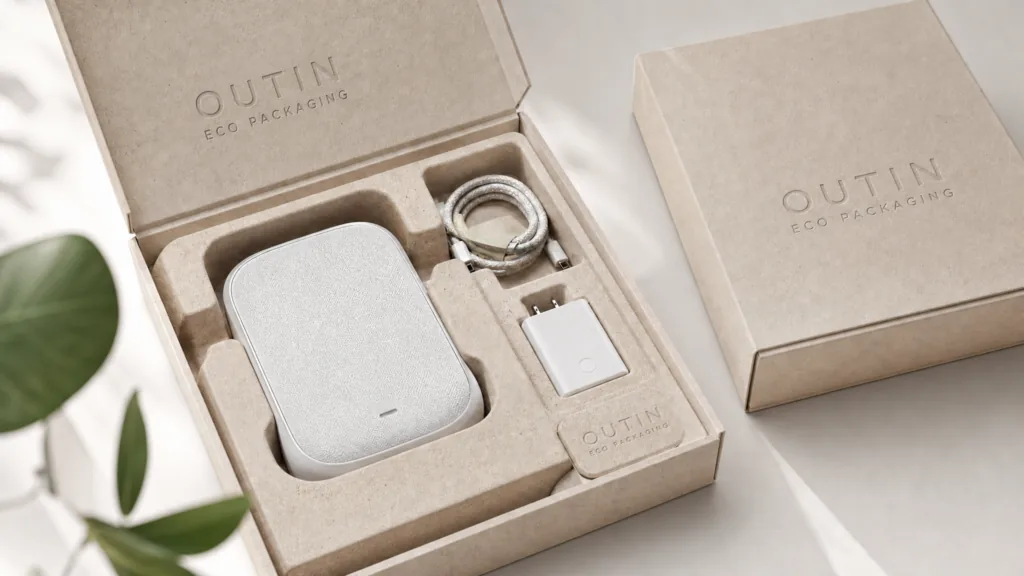
- Traps and inserts — a shaped nest inside a carton or box, holding one product or a set. The most common retail format, and the one that benefits most from wet-press.
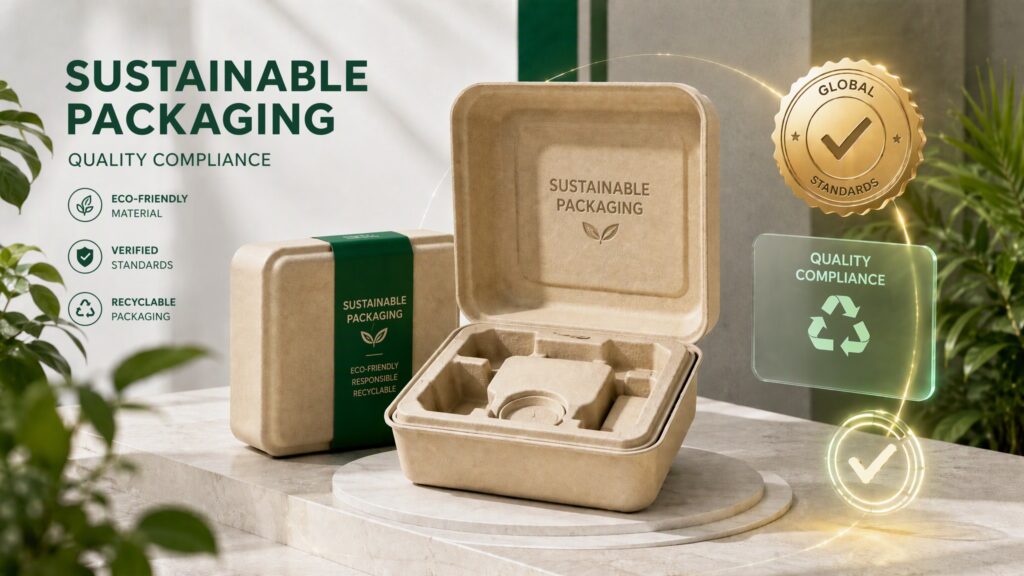
- Clamshells and two-piece boxes — a base and a lid, hinged or separate, used where the packaging itself is the presentation layer.
- End caps and corner protectors — dry-press or thick-wall parts that locate a product inside a shipping carton without a full insert.
- Shippers and wine / bottle packs — deep-draw dry-press parts with moulded cavities sized to a bottle profile.
- Trays and food service — shallow, nestable, often bagasse, frequently specified against food-contact requirements.
- Egg trays and agricultural trays — the original high-volume format, almost always recycled fibre.
Inside molded pulp packaging, the format decision drives the process decision more often than buyers expect. A clamshell with a living hinge is a wet-press or thermoformed part, because a dry-press wall will not fold reliably at the hinge. A shipper for a 1.5 kg bottle is a dry-press part, because the cushioning comes from wall thickness rather than from precision. If you are comparing suppliers rather than formats, our supplier comparison notes cover what separates one factory from another.
What it does well, and where it fails
Molded pulp packaging earns its place in three jobs: it locates a product precisely inside a box, it absorbs impact without foam, and it collapses the volume of a shipment because nestable parts stack. Those three jobs are why the format survives even when plastic is cheaper per unit.
| Property | Behaviour | Practical consequence |
|---|---|---|
| Impact absorption | Good, and predictable when tested | Test to ISTA 3A or ASTM D5276 rather than relying on wall thickness |
| Compression / stacking | Strong when ribs are designed in | A flat-faced part crushes where a ribbed part does not |
| Moisture | Absorbs humidity, softens when wet | Not for frozen or wet-liner logistics without a barrier |
| Dimensional stability | Moves with humidity after production | Hold a climate-stable sample before approving a tight fit |
| Abrasion | Fibre can scuff polished surfaces | Use a smoother wet-press face or an interlayer for high-gloss products |
| Repeatability | Good within a run, weaker across furnishes | Pin the furnish in the specification, not in the email thread |
The honest limitation of molded pulp packaging is moisture. Fibre is hygroscopic, and a part that measures correctly in a dry warehouse will measure differently after a month in a humid container. For most consumer packaging this is irrelevant. For precision electronics with a tight cavity, it means the cavity should be designed with clearance rather than an interference fit, and the incoming inspection should be done after the parts have acclimatised.
Sustainability, without the greenwash
The environmental case for molded pulp packaging rests on three verifiable claims and one that is usually overstated.
Verifiable: the part is made from plant fibre, most of it a residue or a recycled stream, so it does not compete with food crops in the way starch-based foams can. It is recyclable in the paper stream in most markets, provided it is not contaminated with a coating or laminated film. And it is nestable, which reduces shipped volume — the logistics saving is real and measurable in cartons per pallet, not just in marketing copy.
Usually overstated: compostability. Industrial compostability is a property of a specific grade, certified against a specific standard such as EN 13432, and it says nothing about what happens in a home compost heap or in a landfill. A supplier who says “our packaging is compostable” without naming a standard and a certificate number is telling you about an intention, not a property.
Two further points belong in a serious molded pulp packaging evaluation. In molded pulp packaging, recycled content and recyclability are different claims and are frequently conflated; a part can be 100% recycled content and still be difficult to recycle if it carries a coating. And the recycled fibre supply is not unlimited — as more brands move to fibre packaging, the furnish that used to be cheap becomes contested, which is a cost risk worth writing into a multi-year agreement.
Cost structure and MOQ
Molded pulp packaging is priced on four lines, not one: material, tooling, conversion and freight. Most comparative quotations fail because suppliers quote different scopes — one includes tooling, one excludes it, one prices ex-works and one delivers.
| Item | What to expect |
|---|---|
| Tooling | From US$2,400 for a multi-cavity thin-wall tool; final cost depends on design, part size, process and cavity count. Paid on the first order, not on repeats. |
| MOQ | 1,000 pcs wet-press, 5,000 pcs dry-press. |
| Sampling | 10–15 working days. Charged at mould plus courier only — material and labour are free. |
| Production | 15–20 working days after sample approval. |
| Terms | EXW, FOB, CIF or DDU, quoted to the buyer’s preference. |
The full molded pulp packaging cost breakdown, including what a unit price silently excludes and the four errors that make two quotes incomparable, is on our molded pulp packaging cost page.
Certifications and declarations
In molded pulp packaging, this is the area where buyers most often accept a logo where they should have asked for a document. Four categories are routinely mixed together:
- Food-contact declarations — a statement that the material complies with a regulation such as FDA 21 CFR 176.170 and 176.180 for paper and paperboard components. This is a declaration of compliance, not a certificate, and it has no certificate number.
- Restricted-substance declarations — for example RoHS (EU) 2011/65/EU. Packaging itself sits outside the scope of RoHS, but buyers shipping trays alongside electronics are routinely asked for a declaration anyway.
- Certification schemes — third-party assessment against a published standard, such as EN 13432 for industrial compostability, or ISO 9001 for a quality management system. These carry a certificate number and a defined scope, issued to a specific grade or site.
- Regulatory readiness — the EU Packaging and Packaging Waste Regulation, PPWR (EU) 2025/40, is a legal framework rather than a certification. Nobody can be “PPWR certified”; what a supplier can do is evidence that a packaging format is being prepared against its requirements.
Outin holds FDA and RoHS declarations and is running a PPWR readiness programme. For a full treatment of the vocabulary and what each document actually proves, see our molded pulp packaging certifications guide. Outin holds FDA and RoHS declarations and is running a PPWR readiness programme; we do not claim certifications we do not hold, and we will always send the document rather than the logo.
How to specify it: a 12-point RFQ checklist
A molded pulp packaging enquiry that carries these twelve items will produce comparable quotes. An enquiry that carries a picture and a quantity will produce a price and a revision.
- Product dimensions, weight, and centre of gravity.
- Products per pack, and whether the pack is retail or transit.
- Which faces of the product must not be touched, marked or loaded.
- Required locating features — what must be held, and to what accuracy.
- Cosmetic zone: which surfaces are visible to the end customer.
- Drop and compression requirement, by test standard if one applies (ISTA 3A, ASTM D5276).
- Process preference, or the constraint that determines it (thickness, finish, MOQ).
- Annual volume, order frequency, and the largest single order expected.
- Fibre grade and colour target, with an agreed tolerance.
- Printing or embossing: logo, batch code, recycling mark.
- Compliance documents required, named by regulation rather than by logo.
- Incoterm, destination, and whether tooling is to be amortised into the unit price.
Five mistakes that cost buyers money
Comparing an ex-works price to a delivered price. The gap can exceed the difference between two suppliers. Normalise to one Incoterm before comparing anything.
Specifying a tool tolerance as a part tolerance. A ±0.02 mm cavity does not deliver a ±0.02 mm part. Ask what the part will measure after acclimatisation, and inspect at that point.
Designing a part that cannot be demoulded. Zero draft, a sharp internal corner, or a rib too deep for the wall will be discovered at the sample stage, when the tool is already cut. A design review before tooling costs nothing; a tool revision after tooling costs the price of the tool.
Choosing a process by price alone. Dry-press is cheaper per unit at volume and wrong for a retail insert that has to look smooth. The right question is which process holds the feature you cannot compromise, then price it.
Treating the sample as the specification. A good sample with no written specification is a single good day. The specification is what protects the second order, and it should be a document with tolerances, furnish, cosmetic acceptance and test methods — not a photo in a chat thread.
Frequently asked questions
What is molded pulp packaging made of?
It is made from plant fibre suspended in water and formed onto a shaped tool. The fibre is usually recycled paper, sugarcane bagasse, bamboo or wood pulp. No plastic binder is required for the structural part, although coatings can be added for moisture or grease resistance.
Is molded pulp packaging the same as molded fiber packaging?
Yes. Molded pulp, molded fiber, moulded fibre and moulded pulp are the same format under different regional spellings. The term molded pulp is more common in packaging procurement, molded fiber in North America, and moulded pulp in the UK and EU.
What is the minimum order quantity for molded pulp packaging?
At Outin, 1,000 pieces for wet-press and 5,000 pieces for dry-press. MOQ is driven by tool setup and drying capacity rather than by material cost, which is why it differs by process rather than by part size.
How thick can molded pulp packaging be?
For the two processes we quote, wet-press runs 0.8–1.5 mm and dry-press runs 1–3 mm. Thick-wall cushioning formats are substantially thicker and are a different supply chain, formed and oven-dried rather than pressed.
How much does molded pulp tooling cost?
From US$2,400 for a multi-cavity thin-wall tool. The final figure depends on design complexity, part size, process and cavity count, and it is quoted against a drawing. Tooling is paid on the first order; repeat orders carry no tooling charge while the design is unchanged.
Is molded pulp packaging recyclable?
Yes, in the paper stream in most markets, provided the part is not contaminated by a coating or laminated film. Recyclability is a property of the specific part and its coating, so it should be confirmed per SKU rather than assumed from the material name.
Can molded pulp packaging be compostable?
Some grades are industrially compostable and certified against a standard such as EN 13432. That certification applies to a specific grade and carries a certificate number; it does not mean the part will break down in a home compost heap or in landfill.
How long does a molded pulp project take?
Sampling takes 10–15 working days and production takes 15–20 working days after sample approval, at Outin. Add design review and tool making before the first sample, and freight after production.
Next step. If you have a product drawing and a target market, send both and we will tell you which process fits, what the tooling will cost, and where the design will fight the process. Use the contact form, read how we work, or start with the case for molded pulp trays and inserts first if you are still building the internal business case.