The short answer
- Tooling starts at US$2,400 for a multi-cavity thin-wall tool. The final figure depends on design, part size, process and cavity count.
- MOQ is 1,000 pcs for wet-press and 5,000 pcs for dry-press.
- Tooling is paid on the first order only. Repeat orders carry no tooling charge, and the tool stays usable for years as long as the design is unchanged.
- Samples cost mould plus courier only — material and labour are free.
- Quotations are issued on EXW, FOB, CIF or DDU depending on how you buy.
Most molded pulp quotations are impossible to compare, because suppliers quote different scopes: one includes tooling, one excludes it, one prices FOB and one prices EXW. This page sets out how we price a program, so you can line our quote up against another and see where the difference actually sits. If the format itself is new to you, start with what molded pulp packaging is — this page assumes you have already chosen it.
The molded pulp price has four lines, not one
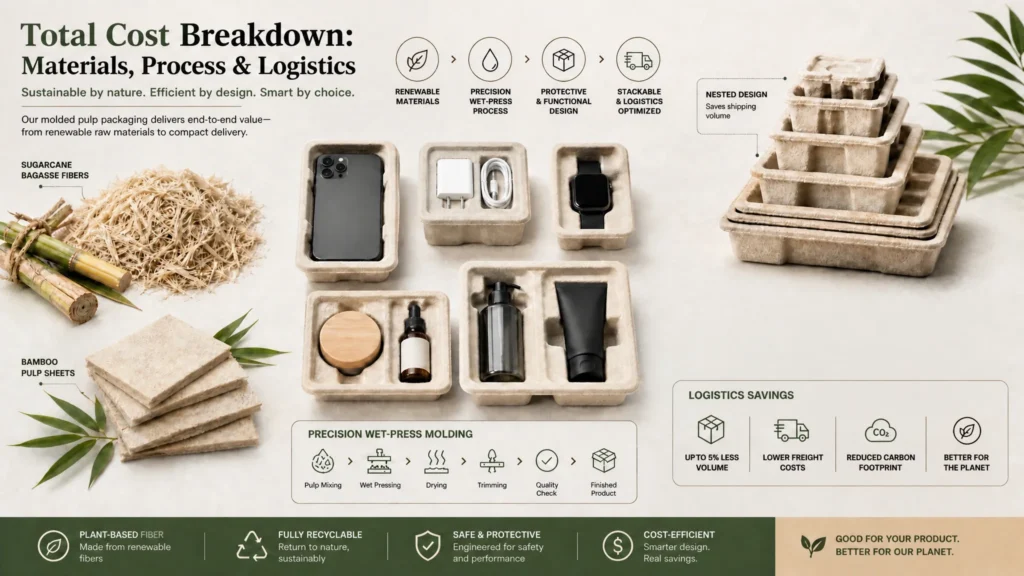
A per-unit price for a molded pulp part is the sum of four things. Ask any supplier to break their number into these four, and the comparison becomes possible.
- Material — unit weight in grams × pulp price per tonne. Pulp is bought by the tonne; the grade (bagasse, recycled newsprint, mixed) changes both price and surface quality.
- Tooling amortisation — tool cost ÷ order quantity. This is the line most often hidden.
- Conversion — forming, pressing, drying, trimming, plus any printing, coating or embossing.
- Freight and terms — EXW, FOB, CIF or DDU; the unit price can differ by more than the tooling line depending on which one is quoted.
Molded pulp tooling: from US$2,400, and four variables that move it
Our tooling starts at US$2,400 for a multi-cavity thin-wall tool. It is not a price list, because four variables each move the figure:
| Variable | Effect on tooling cost |
|---|---|
| Cavity count | Each additional cavity multiplies the tool, but divides the cycle cost per part |
| Part size | Larger footprint needs a larger tool, more mesh area and a bigger press |
| Process | Wet-press matched tools cost more than dry-press forming tools at the same footprint |
| Design and finishing | Undercuts, tight radii, embossed logos and printing areas all add machining and trial cycles |
Two parts with an identical footprint can differ by an order of magnitude once cavity count and design are counted — which is why we quote against your drawing rather than from a table.
Tooling is a one-time cost, not a per-order cost
This is the point buyers most often get wrong, and it changes the economics of a switch:
- First order — tooling is invoiced with the first production run.
- Repeat orders — no tooling charge, ever, as long as the design is unchanged.
- Tool life — a pulp tool runs for years. It is a machined metal mesh form, not a consumable.
- What resets the clock — only a design change: a new cavity layout, a different part size, or a different surface requirement.
So the correct way to judge a molded pulp quotation is cost over the life of the tool, not cost of the first shipment. A supplier who quotes a lower tool but re-charges it on every reorder is more expensive by the third run.
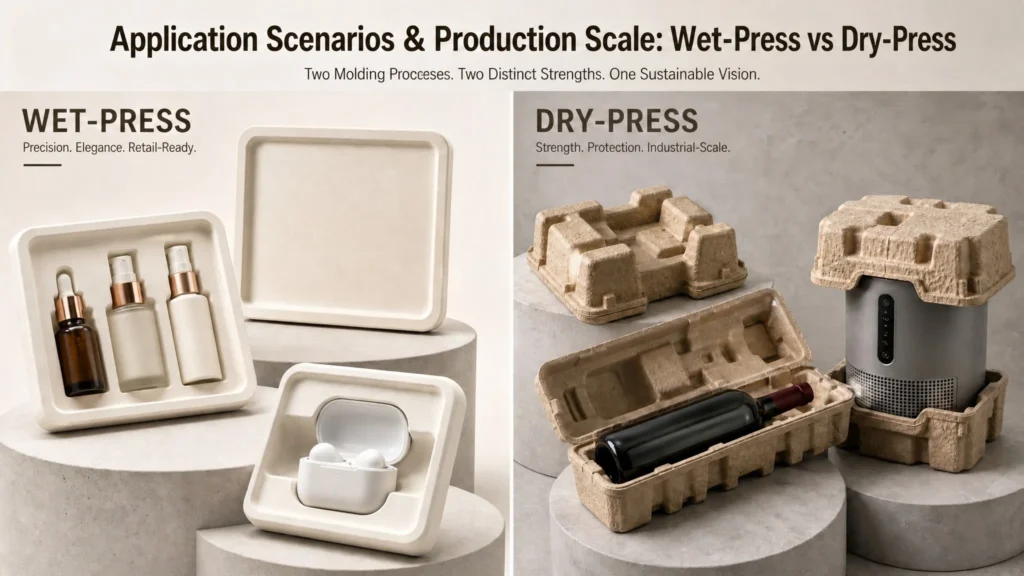
MOQ: 1,000 pcs wet-press, 5,000 pcs dry-press
MOQ follows the process, because the two processes have different setup economics.
| Process | MOQ per SKU | Typical use |
|---|---|---|
| Wet-press | 1,000 pcs | Retail-facing trays and inserts: cosmetics, electronics, gift packaging |
| Dry-press | 5,000 pcs | Higher-volume cushioning: produce, egg, industrial protective trays |
Above those floors, unit price steps down with quantity. Ask for the price at three volumes — for example 1k, 5k and 10k — rather than a single figure at an unstated quantity.
Sampling: mould plus courier, nothing else
We charge the mould cost and the courier fee only. Material and labour for the sample run are free. Two practical consequences:
- The sample is not a profit line — do not read a high sample charge as a sign of quality, or a low one as a bargain.
- Sampling lead time is 10–15 working days from drawing approval; production runs 15–20 working days from sample approval.
Incoterms: EXW, FOB, CIF and DDU
We quote on whichever term fits how you buy. The unit price is not comparable across terms, so always state the term before comparing two suppliers.
| Term | What it covers | Choose it when |
|---|---|---|
| EXW | Ex works — goods available at our factory | You have your own forwarder and want the lowest quoted unit price |
| FOB | Delivered on board at the loading port | You control the main freight and insurance |
| CIF | Cost, insurance and freight to your port | You want one number to your destination port |
| DDU | Delivered to your address, duty unpaid | You want door delivery without handling import agents, and will settle duty yourself |
Tooling and pulp products are quoted separately — one line for the tool, one line for the parts — so you can see exactly what is recurring and what is one-off.
What the unit price does not include
Four costs sit outside a molded pulp unit price, and each one is a common reason two quotes look far apart when they are actually close.
- Freight and insurance — included under CIF and DDU, excluded under EXW and FOB. On low-density packaging this line can exceed the part cost.
- Import duty and VAT — payable on arrival under EXW, FOB and CIF; under DDU the duty is still yours to settle, only the delivery is arranged.
- Artwork, plates and print setup — charged once if the tray is printed or embossed, separate from tooling.
- Storage and split shipments — a molded pulp order made in one run and released in three shipments carries handling cost that a single-shipment price does not reflect.
Four quoting mistakes that distort the comparison
- Comparing a price at an unstated quantity. A molded pulp unit price at 1,000 pcs and one at 10,000 pcs are not the same product commercially, even when the drawing is identical.
- Comparing EXW with CIF. Add the freight line to the EXW quote before you compare, or the cheaper-looking number is simply the one with less included.
- Comparing tooling-inclusive with tooling-separate. A quote with the tool amortised into the unit price looks higher per part and lower at the start — and becomes the expensive one by the third reorder.
- Ignoring the second sample round. If the first sample fails and the tool needs rework, some suppliers re-charge. Ask what happens before you sign.
How to build a comparable quote
Before comparing two suppliers, put both quotes into this shape:
- Unit price, stated per quantity — not “per piece” at an unstated volume.
- Tooling, stated separately, with cavity count.
- Incoterm and port/destination.
- Whether tooling is one-time or per order.
- Sample and courier charges.
- Lead times, sampling and production quoted separately.
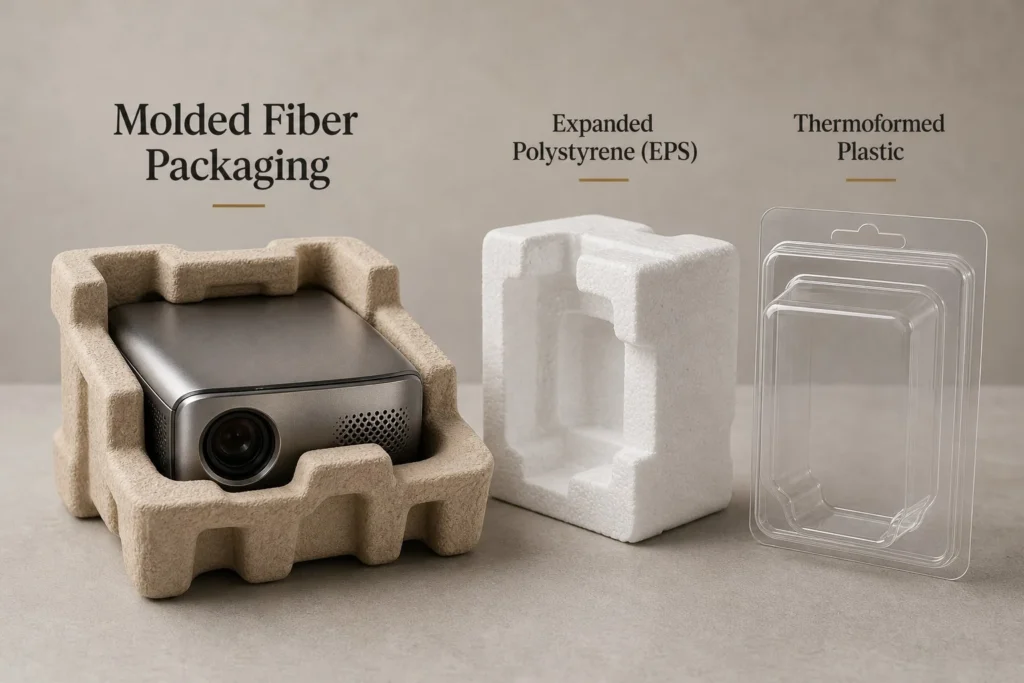
If a supplier cannot fill in line 4, that is the question to ask before price. If you are still choosing between materials rather than suppliers, our comparison of molded pulp against plastic, foam and corrugated covers the cases where fibre loses.
Cost and MOQ FAQ
How much does molded pulp tooling cost?
Ours starts at US$2,400 for a multi-cavity thin-wall tool. Cavity count, part size, process and design complexity each move it, so the figure is quoted against your drawing rather than from a list.
Do I pay tooling again on repeat orders?
No. Tooling is charged on the first order only. Repeat orders carry no tooling charge as long as the design is unchanged, and a pulp tool stays usable for years.
What is the minimum order quantity?
1,000 pcs for wet-press and 5,000 pcs for dry-press, per SKU. Which one applies follows from the surface and tolerance your part needs, not from your budget.
Are samples free?
You pay the mould cost and the courier fee only — material and labour for the sample run are free. Sampling takes 10–15 working days from drawing approval.
Which incoterm do you quote?
EXW, FOB, CIF or DDU, whichever fits your buying process. Tooling and parts are always quoted as separate lines.
Why did two suppliers quote very different unit prices?
Usually one is EXW and the other CIF, or one has baked the tooling into the unit price and the other has not. Normalise both into the six-line shape above before drawing a conclusion.
Next step
Send a 3D file or a physical sample with packed weight and annual quantity, and we return a tool quote, a unit price at three volumes, and a lead time — no obligation.
Related: wet-press vs dry-press: thickness, tolerance and MOQ · certifications and test standards · why brands switch to molded pulp